- 報告書
- ベースライン版 2026
- Complete edition
Global Water Risk and Resilience Report 2026
The State of the World’s Water System
Imprint
- 編集者
- Saeed Valadbaygi, Chief Steward and Managing Editor, the Global Centre for Risk and Innovation (GCRI)
- Editorial team
- Editor 17, Series Editor (to be appointed) (Supervision; Writing – review & editing)
- Researcher 20, Series Researcher (to be appointed) (Investigation; Writing – original draft)
- Editor 4, Desk Editor (to be appointed) (Supervision; Writing – review & editing)
- Assistant 2, Desk Assistant (to be appointed) (Project administration)
- Researcher 1, Researcher (to be appointed) (Investigation; Writing – original draft)
- Researcher 2, Researcher (to be appointed) (Investigation; Writing – original draft)
- Statistician 2, Statistician (to be appointed) (Formal analysis; Validation)
- Fact-checker 1, Fact-checker (to be appointed) (Validation)
- Community Editor 1, Community Editor (to be appointed) (Project administration)
- Statistician 1, Statistical Editor (to be appointed) (Formal analysis; Validation)
- Data Editor 1, Data Editor (to be appointed) (Data curation)
- Copy Editor 1, Copy Editor (to be appointed) (Writing – review & editing)
- Production Editor 1, Production Editor (to be appointed) (Visualisation; Software)
- Sign-offs
- Editorial read: Not yet signed
- Statistical review: Not yet signed
- Copy edit: Not yet signed
- 正式な発行者
- The Global Centre for Risk and Innovation (GCRI) for the Nexus Consortium, Toronto
- Report number
- NR-SECTOR-WATER-GLOBAL-2026-BASELINE
- エビデンス締め切り
- 21 November 2026, cut DC-SECTOR-WATER-GLOBAL-2026-B0
- ステータス
- Draft under stewardship review; not yet released
- DOI and UNI
- Issued at deposit
- ライセンス
- CC BY 4.0 for Nexus-authored text, tables and figures; third-party material keeps its own licence
- Cite as
- Valadbaygi, S. (Ed.). (2026). Global Water Risk and Resilience Report 2026: The State of the World’s Water System (Baseline Edition 2026, Report No. NR-SECTOR-WATER-GLOBAL-2026-BASELINE) [Draft under review]. The Global Centre for Risk and Innovation (GCRI). https://therisk.global/nexus-reports/editions/gs-01/
目次
- ·
- 1
- 2
- 3
- 4
- 5
- 6
- 7
- 8
- A
- B
- C
- Global Water 2026
- Executive summary
Executive summary
The edition on a few pages: the abstract, the key messages, the headline finding and what each steward reads in it.
S.1Abstract
The world enters 2027 with a water system under strain from both ends. In 2024, 2.1 billion people still lacked safely managed drinking water and 3.4 billion lacked safely managed sanitation1. Roughly half of the world’s people experience severe water scarcity for at least part of the year2. The year 2023 was the driest for the world’s rivers in 33 years, and glaciers lost more than 600 gigatonnes of water, the largest annual loss in five decades5. Floods, storms and wildfires caused US$166 billion of 2025’s disaster losses7, while freshwater wildlife populations have fallen by 85% on average since 197017. Agriculture takes about 70% of withdrawals2, so water stress travels directly into food prices, hydropower, health and ecosystems. This Baseline Edition fixes the 2026 reference state of the global water system, maps its couplings to energy, food, health and nature, and sets the questions the 2027 edition will answer from basin and national evidence. It ranks no country or basin.
S.2Key messages
Six readings that frame the water baseline, and the eight questions this edition answers: each with its status and source.
2.1 billion people lacked safely managed drinking water and 3.4 billion safely managed sanitation in 2024.1
Who lacks safe water?Reported
Roughly half of the world’s people face severe scarcity for part of each year.222
How widespread is scarcity?Reported
2023 was the driest year for rivers in 33 years; glaciers lost more than 600 Gt.5
Is the water cycle changing?Reported
It supplies about half of domestic water, and declines have accelerated in many aquifers.420
What about groundwater?Reported
Agriculture uses about 70% of withdrawals; drought cuts yields and raises prices.215
How does water drive food risk?Reported
Hydropower and thermal cooling depend on flows; drought cuts both.14
How does water drive energy risk?Inferred
Freshwater wildlife fell by 85% on average since 1970; wetlands shrank by 22%.1718
How healthy is freshwater nature?Reported
A multi-basin drought cutting hydropower and irrigated yields at once. SCN-GS01-MBD-01
What will 2027 test first?Expert input
S.3Headline finding
ReportedEQL 5NRF-SECTOR-WATER-GLOBAL-2026-BASELINE-WAT-001
In 2024, 2.1 billion people lacked safely managed drinking water and 3.4 billion lacked safely managed sanitation, and 1.7 billion lacked basic hygiene services at home.
| 項目 | Bar, scaled to the largest value | 値 |
|---|---|---|
| Safely managed drinking water | 2.1 | |
| Safely managed sanitation | 3.4 |
Source: WHO/UNICEF JMP 20251.
Service gaps concentrate in low-income, rural and fragile settings, where they compound health, education and gender inequalities and leave households most exposed when drought or flood strikes. Closing them is also climate adaptation110.
S.4At a glance
S.5What each steward reads in it
GCRI · KEY T
Technical Truth
The evidence supports reading water as the coupling layer of the WEFH+B system.
GRF · KEY M
Public Meaning
For most people water risk arrives as a dry tap, a flooded street or a higher food price.
GRA · KEY F
Capital Meaning
Readiness implications only. Flood losses are large and often uninsured, water investment falls short of need, and nature-related disclosure is spreading.
NEXUS
統合
The water system is well studied and thinly governed at the scale where its risks travel.
S.6What this edition is, and is not
What this edition is
A baseline: the state of water access, scarcity, groundwater, glaciers and extremes in 2026, and the couplings through which water carries risk into energy, food, health and nature. It synthesises published global evidence; it ranks no country or basin.
何でないか
Not a water-stress ranking, an allocation recommendation or an assessment of any utility, basin authority or government. Water rights and management rest with national and local authorities and basin organisations.
What comes next
National water chapters and basin evidence feed the 2027 water edition through the federation. Each edition reports what changed against this baseline: observations, source revisions, method changes, scenario updates and corrections.
Notes
Numbers are the edition’s reference numbers, so a note reads the same in every chapter. The full list, with every source and its licence, is in Annex C. Annex C, references
- 1WHO and UNICEF (eds.), Progress on Household Drinking Water, Sanitation and Hygiene 2000–2024: Special Focus on Inequalities. Joint Monitoring Programme, New York and Geneva, 2025. Accessed 2026-11-21. https://washdata.org/reports/jmp-2025-wash-householdsback
- 2UNESCO World Water Assessment Programme (ed.), The United Nations World Water Development Report 2024: Water for Prosperity and Peace. UNESCO, Paris, 2024. doi:10.54679/wzdq6209 doi:10.54679/wzdq6209back
- 5WMO (ed.), State of Global Water Resources 2023. World Meteorological Organization, Geneva, 2024. doi:10.18356/9789263113627 doi:10.18356/9789263113627back
- 7Munich Re (ed.), Natural disasters in 2025: NatCatSERVICE full-year figures. Munich Re, Munich, January 2026. Accessed 2026-11-22. https://www.munichre.com/en/company/media-relations/media-information-and-corporate-news/media-information/2026/natural-disaster-figures-2025.htmlback
- 17WWF (ed.), Living Planet Report 2026: The Science of Hope. WWF, Gland, October 2026. Accessed 2026-11-21. https://livingplanet.panda.org/back
- 22M. M. Mekonnen and A. Y. Hoekstra, “Four billion people facing severe water scarcity,” Science Advances, vol. 2, e1500323, 2016. doi:10.1126/sciadv.1500323 doi:10.1126/sciadv.1500323back
- 4UNESCO World Water Assessment Programme (ed.), The United Nations World Water Development Report 2022: Groundwater, Making the Invisible Visible. UNESCO, Paris, 2022. doi:10.54679/caos3862 doi:10.54679/caos3862back
- 20S. Jasechko, H. Seybold, D. Perrone et al., “Rapid groundwater decline and some cases of recovery in aquifers globally,” Nature, vol. 625, pp. 715–721, 2024. doi:10.1038/s41586-023-06879-8 doi:10.1038/s41586-023-06879-8back
- 15FAO (ed.), The State of the World’s Land and Water Resources for Food and Agriculture 2021: Systems at Breaking Point. FAO, Rome, 2021. doi:10.4060/cb9910en doi:10.4060/cb9910enback
- 14International Energy Agency (ed.), Water–Energy Nexus. World Energy Outlook 2016 Special Report. IEA, Paris, 2016. Address from the issuer’s own site; not opened here: the site refuses automated requests. https://www.iea.org/reports/water-energy-nexusback
- 18Ramsar Convention Secretariat (ed.), Global Wetland Outlook 2025. Ramsar Convention Secretariat, Gland, 2025. doi:10.69556/gwo-2025-eng doi:10.69556/gwo-2025-engback
- 10UN-Water (ed.), Blueprint for Acceleration: Sustainable Development Goal 6 Synthesis Report on Water and Sanitation 2023. United Nations, Geneva, 2023. doi:10.18356/9789210026444 doi:10.18356/9789210026444back
- 9UNECE and UNESCO (eds.), Progress on Transboundary Water Cooperation: Mid-term status of SDG Indicator 6.5.2, with a special focus on Climate Change, 2024. United Nations and UNESCO, Geneva and Paris, 2024. Observation year 2023. Accessed 2026-11-22. https://www.unwater.org/sites/default/files/2024-09/SDG6_Indicator_Report_652_Progress-on-Transboundary-Water-Cooperation_2024_EN.pdfback
- 38WHO (ed.), Burden of Disease Attributable to Unsafe Drinking-water, Sanitation and Hygiene: 2019 Update. WHO, Geneva, 2023. Accessed 2026-11-21. https://www.who.int/publications/i/item/9789240075610back
- 39UNICEF (ed.), The Climate-Changed Child: A Children’s Climate Risk Index Supplement. UNICEF, New York, 2023. Accessed 2026-11-21. https://www.unicef.org/reports/climate-changed-childback
- Global Water 2026
- Chapter 1
Water is where the systems meet
Part I describes systems and their couplings. It ranks no country or basin and assesses no utility or authority.
1.1The questions this part answers
Key questions
- Where is water risk concentrated: in access, scarcity, groundwater or extremes?
- Which couplings carry water shocks into energy, food and health?
- Which water capabilities hold under compound stress?
- What must basin evidence measure first in 2027?
In this part
- ナラティブ
- Headline finding
- Lead figure
- Five coupling chapters
- Twelve-domain reading
- Sector screens
- Dependency matrix
- Risk objects
- Capability ladder
- シナリオ
- Three lenses
- ポートフォリオ
1.2The argument
Water is usually reported as a sector: utilities, irrigation, flood defence. The 2026 evidence reads it as the medium through which almost every other system’s risk travels. Agriculture takes about 70% of withdrawals2, thermal power plants and hydropower depend on flows14, disease follows unsafe water38, and freshwater ecosystems are declining faster than any other realm17.
Access is still unfinished. In 2024, 2.1 billion people lacked safely managed drinking water, 3.4 billion lacked safely managed sanitation and 1.7 billion lacked basic hygiene services at home1. At current rates the world will not reach the 2030 targets for water and sanitation10. Unsafe water, sanitation and hygiene were linked to about 1.4 million deaths in 2019, most of them from diarrhoeal disease38.
Scarcity is now a seasonal condition for half of humanity. Roughly half of the world’s people experience severe water scarcity for at least part of the year222, and global water use has risen by about 1% a year for four decades3. About 739 million children live in areas of high or extremely high water scarcity39.
The water cycle itself is shifting. 2023 was the driest year for global rivers in 33 years, and glaciers lost more than 600 gigatonnes of water, the largest loss in five decades5. Glacier mass loss has accelerated this century21, and groundwater declines have accelerated in many of the world’s aquifers20. Groundwater supplies about half of domestic water and a quarter of irrigation4.
Extremes carry the costs. Floods, severe storms and wildfires caused US$166 billion of the US$224 billion in natural-disaster losses in 20257. Drought is less visible in loss data, but it moves through food prices, hydropower output and public budgets. Water scarcity could cost some regions up to 6% of GDP by 205035.
Governance is shared and incomplete. 153 countries share transboundary rivers, lakes or aquifers, but most do not yet have operational arrangements covering all of them9. The December 2026 UN Water Conference is the first chance since 2023 to set a common direction43.
This edition therefore reads water as the coupling layer of the WEFH+B system. The matrix, risk objects, capability ladder and scenario that follow ask the same two questions: where does a water shock travel next, and who holds the capability to stop it?
More people lack safe sanitation than safe drinking water. All three gaps are concentrated in the same places (low-income, rural and fragile settings) so they compound each other’s health effects1.
| 項目 | Bar, scaled to the largest value | 値 |
|---|---|---|
| Safely managed sanitation | 3.4 | |
| Safely managed drinking water | 2.1 | |
| Basic hygiene | 1.7 |
Source: as cited in the note to this figure. Year 2024.
Figure ID FIG-SECTOR-WATER-GLOBAL-2026-BASELINE-01-003
1.3The six-sector nexus: twenty couplings across five assessed sectors
The water-centred matrix types the twenty couplings between the five core systems, read for their water content. Strengths are Nexus estimates from the cited assessments and analogue events; they set the graph that basin evidence will test in 2027.
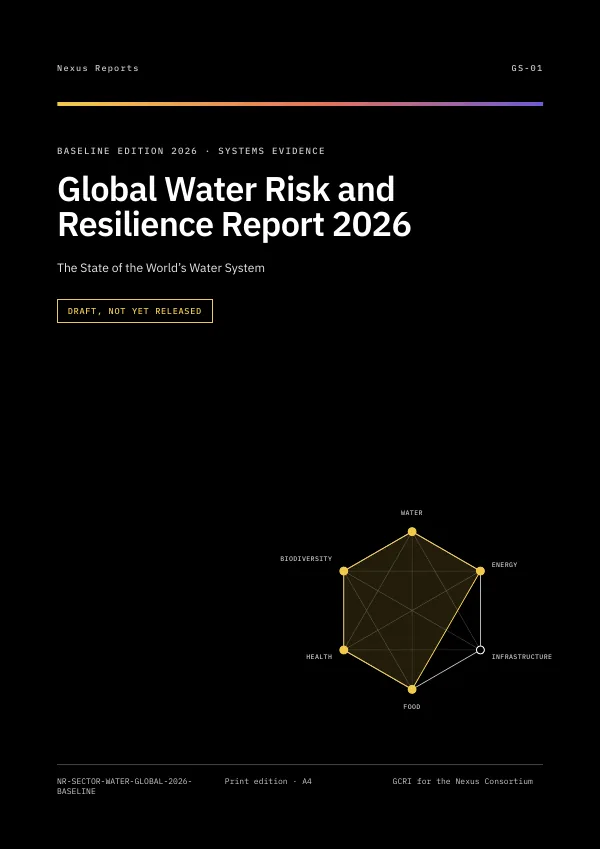
Each line is one coupling from one sector to another, drawn by the strength the edition assigns. Strengths are Nexus estimates from the cited evidence and analogue events. Infrastructure: not assessed in this edition’s coupling matrix, so it is drawn hollow with no couplings. The hexagon is the estate doctrine: six sectors and fifteen relations.
- Strong
- 中程度
- Weak
- Not assessed in this edition
Source: this edition’s coupling matrix (Table 1.1); status Estimated. Hexagon: the estate doctrine (Signature).
| From, to | WAT | ENE | FOO | HLT | BIO |
|---|---|---|---|---|---|
| WAT 水 | · | STRONG hydro · thermal cooling | STRONG irrigation · rain-fed yield | STRONG safe water · sanitation | STRONG flows · wetlands |
| ENE エネルギー | MODERATE pumping · treatment · desalination | · | STRONG fuel · fertiliser · cold chain | STRONG air pollution · cooling | MODERATE land use · mining |
| FOO 食料 | STRONG ≈70% of withdrawals | WEAK バイオエネルギー原料 | · | STRONG nutrition · food safety | STRONG 土地転換 |
| HLT 健康 | WEAK workforce | WEAK workforce | MODERATE labour · disease | · | WEAK residues |
| BIO 生物多様性 | STRONG regulation · filtration | MODERATE biomass · hydrology | STRONG pollination · soils | MODERATE zoonoses · medicines | · |
| Strength: strong, moderate or weak; a Nexus estimate (status Estimated) from cited evidence and analogue events. The scale is defined in Annex A. | |||||
Transmission paths
- 01
CLI → WAT → ENE
Drought lowers reservoirs and warms cooling water; hydro and thermal output fall.
Reported 2022 drought, Europe and China
- 02
CLI → WAT → FOO
Multi-basin drought cuts irrigated and rain-fed yields.
Inferred 2010–2012 droughts
- 03
WAT → HLT
Floods contaminate supplies and spread disease.
Reported major floods since 2010
- 04
FOO → WAT → BIO
Irrigation expansion depletes aquifers and river flows.
Reported aquifer declines20
- 05
WAT → FIN
Flood losses fall on the uninsured and on public budgets.
Reported 2025 losses7
1.4Reinforcing loops
A shock entering either system of a loop can return amplified through the other.
| Loop | First direction | Second direction |
|---|---|---|
| WAT and FOO | Water to food: irrigation · rain-fed yield | Food to water: ≈70% of withdrawals |
| WAT and BIO | Water to biodiversity: flows · wetlands | Biodiversity to water: regulation · filtration |
| FOO and BIO | Food to biodiversity: land conversion | Biodiversity to food: pollination · soils |
| A causal-loop reading of the matrix (Sterman, Business Dynamics, 2000): structural, from estimated strengths, not a measured feedback. | ||
Notes
Numbers are the edition’s reference numbers, so a note reads the same in every chapter. The full list, with every source and its licence, is in Annex C. Annex C, references
- 2UNESCO World Water Assessment Programme (ed.), The United Nations World Water Development Report 2024: Water for Prosperity and Peace. UNESCO, Paris, 2024. doi:10.54679/wzdq6209 doi:10.54679/wzdq6209back
- 14International Energy Agency (ed.), Water–Energy Nexus. World Energy Outlook 2016 Special Report. IEA, Paris, 2016. Address from the issuer’s own site; not opened here: the site refuses automated requests. https://www.iea.org/reports/water-energy-nexusback
- 38WHO (ed.), Burden of Disease Attributable to Unsafe Drinking-water, Sanitation and Hygiene: 2019 Update. WHO, Geneva, 2023. Accessed 2026-11-21. https://www.who.int/publications/i/item/9789240075610back
- 17WWF (ed.), Living Planet Report 2026: The Science of Hope. WWF, Gland, October 2026. Accessed 2026-11-21. https://livingplanet.panda.org/back
- 1WHO and UNICEF (eds.), Progress on Household Drinking Water, Sanitation and Hygiene 2000–2024: Special Focus on Inequalities. Joint Monitoring Programme, New York and Geneva, 2025. Accessed 2026-11-21. https://washdata.org/reports/jmp-2025-wash-householdsback
- 10UN-Water (ed.), Blueprint for Acceleration: Sustainable Development Goal 6 Synthesis Report on Water and Sanitation 2023. United Nations, Geneva, 2023. doi:10.18356/9789210026444 doi:10.18356/9789210026444back
- 22M. M. Mekonnen and A. Y. Hoekstra, “Four billion people facing severe water scarcity,” Science Advances, vol. 2, e1500323, 2016. doi:10.1126/sciadv.1500323 doi:10.1126/sciadv.1500323back
- 3UNESCO World Water Assessment Programme (ed.), The United Nations World Water Development Report 2023: Partnerships and Cooperation for Water. UNESCO, Paris, 2023. doi:10.54679/qqjg4824 doi:10.54679/qqjg4824back
- 39UNICEF (ed.), The Climate-Changed Child: A Children’s Climate Risk Index Supplement. UNICEF, New York, 2023. Accessed 2026-11-21. https://www.unicef.org/reports/climate-changed-childback
- 5WMO (ed.), State of Global Water Resources 2023. World Meteorological Organization, Geneva, 2024. doi:10.18356/9789263113627 doi:10.18356/9789263113627back
- 21R. Hugonnet, R. McNabb, E. Berthier et al., “Accelerated global glacier mass loss in the early twenty-first century,” Nature, vol. 592, pp. 726–731, 2021. doi:10.1038/s41586-021-03436-z doi:10.1038/s41586-021-03436-zback
- 20S. Jasechko, H. Seybold, D. Perrone et al., “Rapid groundwater decline and some cases of recovery in aquifers globally,” Nature, vol. 625, pp. 715–721, 2024. doi:10.1038/s41586-023-06879-8 doi:10.1038/s41586-023-06879-8back
- 4UNESCO World Water Assessment Programme (ed.), The United Nations World Water Development Report 2022: Groundwater, Making the Invisible Visible. UNESCO, Paris, 2022. doi:10.54679/caos3862 doi:10.54679/caos3862back
- 7Munich Re (ed.), Natural disasters in 2025: NatCatSERVICE full-year figures. Munich Re, Munich, January 2026. Accessed 2026-11-22. https://www.munichre.com/en/company/media-relations/media-information-and-corporate-news/media-information/2026/natural-disaster-figures-2025.htmlback
- 35World Bank (ed.), High and Dry: Climate Change, Water, and the Economy. World Bank, Washington, DC, 2016. doi:10.1596/K8517 doi:10.1596/K8517back
- 9UNECE and UNESCO (eds.), Progress on Transboundary Water Cooperation: Mid-term status of SDG Indicator 6.5.2, with a special focus on Climate Change, 2024. United Nations and UNESCO, Geneva and Paris, 2024. Observation year 2023. Accessed 2026-11-22. https://www.unwater.org/sites/default/files/2024-09/SDG6_Indicator_Report_652_Progress-on-Transboundary-Water-Cooperation_2024_EN.pdfback
- 43S. Valadbaygi (ed.), Reports, The Foundational Edition, Volumes I and II. Reports series, Edition 2026–2030, V1.0. GCRI for the Nexus Consortium, Toronto, 2026.back
- 29United Nations General Assembly (ed.), Transforming our World: The 2030 Agenda for Sustainable Development, resolution 70/1. United Nations, New York, 2015. Accessed 2026-11-22. https://docs.un.org/en/A/RES/70/1back
- Global Water 2026
- Chapter 2
Key findings
Twelve findings carry the water baseline. They are grouped by coupling, never ranked. Each resolves to its source or, where Nexus analysis is involved, to its stated method.
2.1Headline finding
ReportedEQL 5NRF-SECTOR-WATER-GLOBAL-2026-BASELINE-WAT-001
In 2024, 2.1 billion people lacked safely managed drinking water and 3.4 billion lacked safely managed sanitation, and 1.7 billion lacked basic hygiene services at home.
| 項目 | Bar, scaled to the largest value | 値 |
|---|---|---|
| Safely managed drinking water | 2.1 | |
| Safely managed sanitation | 3.4 |
Source: WHO/UNICEF JMP 20251.
Implication
Service gaps concentrate in low-income, rural and fragile settings, where they compound health, education and gender inequalities and leave households most exposed when drought or flood strikes. Closing them is also climate adaptation110.
What would move it
The next JMP update, utility investment in fast-growing cities, and the commitments of the December 2026 UN Water Conference would each move this finding.
2.2水
ReportedEQL 5NRF-SECTOR-WATER-GLOBAL-2026-BASELINE-WAT-001
2.1 billion people lacked safely managed drinking water and 3.4 billion lacked safely managed sanitation in 2024.153
ReportedEQL 4NRF-SECTOR-WATER-GLOBAL-2026-BASELINE-WAT-002
Roughly half of the world’s population experiences severe water scarcity for at least part of the year.222
ReportedEQL 4NRF-SECTOR-WATER-GLOBAL-2026-BASELINE-WAT-003
Global water use has grown by about 1% a year over the past forty years.354
ReportedEQL 4NRF-SECTOR-WATER-GLOBAL-2026-BASELINE-WAT-004
2023 was the driest year for global rivers in 33 years, and glaciers lost more than 600 Gt of water.548
ReportedEQL 4NRF-SECTOR-WATER-GLOBAL-2026-BASELINE-WAT-005
Groundwater supplies about half of domestic withdrawals and about a quarter of irrigation water; declines have accelerated in many aquifers.420
2.3食料
ReportedEQL 4NRF-SECTOR-WATER-GLOBAL-2026-BASELINE-FOO-006
Agriculture accounts for about 70% of freshwater withdrawals, tying water stress directly to food production and prices.215
2.4エネルギー
ReportedEQL 3NRF-SECTOR-WATER-GLOBAL-2026-BASELINE-ENE-007
Energy production accounts for about 10% of global freshwater withdrawals, mainly for cooling thermal power plants.1449
2.5健康
ReportedEQL 4NRF-SECTOR-WATER-GLOBAL-2026-BASELINE-HLT-008
Unsafe drinking water, sanitation and hygiene caused about 1.4 million deaths in 2019.3850
2.6生物多様性
ReportedEQL 4NRF-SECTOR-WATER-GLOBAL-2026-BASELINE-BIO-009
Freshwater wildlife populations declined by 85% on average between 1970 and 2022, and 22% of wetland area has been lost since 1970.1718
2.7Climate forcing
ReportedEQL 4NRF-SECTOR-WATER-GLOBAL-2026-BASELINE-CLI-010
Floods, severe storms and wildfires caused US$166 billion of the US$224 billion in natural-disaster losses in 2025.751
2.8ガバナンス
ReportedEQL 3NRF-SECTOR-WATER-GLOBAL-2026-BASELINE-GOV-011
153 countries share transboundary rivers, lakes or aquifers; most do not yet have operational arrangements covering all of them.952
2.9システミック
Expert inputEQL 2NRF-SECTOR-WATER-GLOBAL-2026-BASELINE-SYS-012
The leading compound pathway for 2027 testing is a multi-basin drought that cuts hydropower and irrigated yields at once while heat raises demand. § scenario
Notes
Numbers are the edition’s reference numbers, so a note reads the same in every chapter. The full list, with every source and its licence, is in Annex C. Annex C, references
- 1WHO and UNICEF (eds.), Progress on Household Drinking Water, Sanitation and Hygiene 2000–2024: Special Focus on Inequalities. Joint Monitoring Programme, New York and Geneva, 2025. Accessed 2026-11-21. https://washdata.org/reports/jmp-2025-wash-householdsback
- 10UN-Water (ed.), Blueprint for Acceleration: Sustainable Development Goal 6 Synthesis Report on Water and Sanitation 2023. United Nations, Geneva, 2023. doi:10.18356/9789210026444 doi:10.18356/9789210026444back
- 53United Nations Statistics Division (ed.), SDG Global Database API, indicators 6.1.1 and 6.2.1, World aggregate (series SH_H2O_SAFE, SH_SAN_SAFE; custodian WHO/UNICEF JMP). UN, New York. Observation year 2024. Accessed 2026-11-22. https://unstats.un.org/sdgapi/v1/sdg/Indicator/Data?indicator=6.1.1&areaCode=1back
- 2UNESCO World Water Assessment Programme (ed.), The United Nations World Water Development Report 2024: Water for Prosperity and Peace. UNESCO, Paris, 2024. doi:10.54679/wzdq6209 doi:10.54679/wzdq6209back
- 22M. M. Mekonnen and A. Y. Hoekstra, “Four billion people facing severe water scarcity,” Science Advances, vol. 2, e1500323, 2016. doi:10.1126/sciadv.1500323 doi:10.1126/sciadv.1500323back
- 3UNESCO World Water Assessment Programme (ed.), The United Nations World Water Development Report 2023: Partnerships and Cooperation for Water. UNESCO, Paris, 2023. doi:10.54679/qqjg4824 doi:10.54679/qqjg4824back
- 54FAO (ed.), AQUASTAT: Water use, global water withdrawal trend (methodology page). Food and Agriculture Organization, Rome. Observation year 2010 (series 1900-2010). Accessed 2026-11-22. http://www.fao.org/aquastat/en/overview/methodology/water-use/back
- 5WMO (ed.), State of Global Water Resources 2023. World Meteorological Organization, Geneva, 2024. doi:10.18356/9789263113627 doi:10.18356/9789263113627back
- 48European Commission, Joint Research Centre (ed.), State of Global Water Resources 2023 (AquaKnow news item of 9 October 2024 summarising the WMO report). European Commission, Ispra. Observation year 2023. Accessed 2026-11-21. https://aquaknow.jrc.ec.europa.eu/news/state-global-water-resources-2023back
- 4UNESCO World Water Assessment Programme (ed.), The United Nations World Water Development Report 2022: Groundwater, Making the Invisible Visible. UNESCO, Paris, 2022. doi:10.54679/caos3862 doi:10.54679/caos3862back
- 20S. Jasechko, H. Seybold, D. Perrone et al., “Rapid groundwater decline and some cases of recovery in aquifers globally,” Nature, vol. 625, pp. 715–721, 2024. doi:10.1038/s41586-023-06879-8 doi:10.1038/s41586-023-06879-8back
- 15FAO (ed.), The State of the World’s Land and Water Resources for Food and Agriculture 2021: Systems at Breaking Point. FAO, Rome, 2021. doi:10.4060/cb9910en doi:10.4060/cb9910enback
- 14International Energy Agency (ed.), Water–Energy Nexus. World Energy Outlook 2016 Special Report. IEA, Paris, 2016. Address from the issuer’s own site; not opened here: the site refuses automated requests. https://www.iea.org/reports/water-energy-nexusback
- 49Heinrich-Böll-Stiftung European Union (ed.), Energy: our power craves water (Water Atlas chapter, web edition of 5 November 2025, citing International Energy Agency data for 2021). Heinrich-Böll-Stiftung, Brussels. Observation year 2021. Accessed 2026-11-21. https://eu.boell.org/en/2025/11/05/wateratlas-energy-our-power-craves-waterback
- 38WHO (ed.), Burden of Disease Attributable to Unsafe Drinking-water, Sanitation and Hygiene: 2019 Update. WHO, Geneva, 2023. Accessed 2026-11-21. https://www.who.int/publications/i/item/9789240075610back
- 50J. Wolf, R. B. Johnston, A. Ambelu et al., “Burden of disease attributable to unsafe drinking water, sanitation, and hygiene in domestic settings: a global analysis for selected adverse health outcomes,” The Lancet, vol. 401, pp. 2060–2071, 2023 (abstract read through Europe PMC). Observation year 2019. Accessed 2026-11-21. https://doi.org/10.1016/S0140-6736(23)00458-0 doi:10.1016/S0140-6736(23)00458-0back
- 17WWF (ed.), Living Planet Report 2026: The Science of Hope. WWF, Gland, October 2026. Accessed 2026-11-21. https://livingplanet.panda.org/back
- 18Ramsar Convention Secretariat (ed.), Global Wetland Outlook 2025. Ramsar Convention Secretariat, Gland, 2025. doi:10.69556/gwo-2025-eng doi:10.69556/gwo-2025-engback
- 7Munich Re (ed.), Natural disasters in 2025: NatCatSERVICE full-year figures. Munich Re, Munich, January 2026. Accessed 2026-11-22. https://www.munichre.com/en/company/media-relations/media-information-and-corporate-news/media-information/2026/natural-disaster-figures-2025.htmlback
- 51Insurance Journal (ed.), Wildfires, Storms Fuel 2025 Insured Losses of $108 Billion: Munich Re Report (wire report of 13 January 2026). Wells Media Group, San Diego. Observation year 2025. Accessed 2026-11-21. https://www.insurancejournal.com/news/international/2026/01/13/854041.htmback
- 9UNECE and UNESCO (eds.), Progress on Transboundary Water Cooperation: Mid-term status of SDG Indicator 6.5.2, with a special focus on Climate Change, 2024. United Nations and UNESCO, Geneva and Paris, 2024. Observation year 2023. Accessed 2026-11-22. https://www.unwater.org/sites/default/files/2024-09/SDG6_Indicator_Report_652_Progress-on-Transboundary-Water-Cooperation_2024_EN.pdfback
- 52United Nations (ed.), The Sustainable Development Goals Report 2026, Goal 6: Clean water and sanitation (web chapter). United Nations Department of Economic and Social Affairs, New York, 2026. Observation year 2024. Accessed 2026-11-22. https://unstats.un.org/sdgs/report/2026/Goal-06/back
- Global Water 2026
- Chapter 3
Systems and sectors at baseline
3.1Where each system stood at evidence close
WAT · Water
People without safely managed drinking water
2.1billionand 1.7 billion without basic hygiene services at home.
報告値2024JMP1
ENE · Energy
Share of global freshwater withdrawals for energy
≈10%mostly cooling for thermal power; hydropower adds storage and flow dependence.
報告値2014IEA14
FOO · Food
Share of withdrawals used by agriculture
≈70%Irrigated land produces a large share of the world’s food from a minority of cropland.
HLT · Health
Deaths attributable to unsafe water, sanitation and hygiene
1.4millionin 2019, most of them from diarrhoeal disease.
報告値2019WHO38
BIO · Biodiversity
Average decline of freshwater wildlife populations
−85%1970–2022, the steepest decline of any realm.
報告値1970–2022WWF17
SYS · Cross-system
Driest year for global rivers in 33 years
2023Glaciers lost more than 600 Gt of water in the same year.
報告値2023WMO5
3.2Domain posture
Each of the twelve coupled domains is read through water, in words, not scored. The coupling column names the dependency that carries water risk into each domain.
| 分野 | Posture at baseline | 結合 | ステータス |
|---|---|---|---|
| WAT | Access unfinished; scarcity seasonal for half of humanity; groundwater and glaciers declining. | the core system | Reported EQL 4 |
| ENE | About 10% of withdrawals; hydropower and thermal cooling exposed to low flows and heat. | WAT → ENE | Reported EQL 3 |
| FOO | About 70% of withdrawals; irrigated yields depend on groundwater and glacier-fed rivers. | WAT → FOO | Reported EQL 4 |
| HLT | 1.4 million WASH-attributable deaths in 2019; floods spread water-borne disease. | WAT → HLT | Reported EQL 4 |
| BIO | Freshwater wildlife down 85%; wetlands down 22% since 1970. | WAT ↔ BIO | Reported EQL 4 |
| CLI | Drier rivers, faster glacier loss and more intense extremes with warming. | CLI → WAT | Reported EQL 5 |
| INF | Ageing networks, storage and flood defences; inland shipping exposed to low water. | WAT ↔ INF | Inferred EQL 3 |
| FIN | Flood losses large and often uninsured; water scarcity could cost some regions up to 6% of GDP by 2050. | WAT → FIN | Reported EQL 3 |
| DAT | Water monitoring data are sparse for groundwater and quality. | DAT → WAT | Expert input EQL 2 |
| AIC | Data centres add cooling-water demand; volumes not consolidated globally. | AIC → WAT | Expert input EQL 2 |
| MIN | Mining and refining use and pollute water in already stressed basins. | MIN → WAT | Inferred EQL 2 |
| TRD | Food trade moves “virtual water”; export restrictions follow droughts. | WAT → TRD | Inferred EQL 3 |
3.3Sector screens
All sixteen sectors are screened for their dependence on water, on the same grammar as every national edition. The evidence column describes coverage of the baseline evidence, not the performance of the sector.
| コード | 部門 | Baseline evidence | Exposure to watch | Evidence coverage |
|---|---|---|---|---|
| GS-00 | Cross-system | water couples all five core systems46 | multi-basin drought | PARTIAL |
| GS-01 | 水 | access gaps; seasonal scarcity for half of humanity12 | drought, flood, depletion | GOOD |
| GS-02 | エネルギー | about 10% of withdrawals14 | low flows and hot cooling water | PARTIAL |
| GS-03 | 食料 | about 70% of withdrawals2 | aquifer decline; drought | GOOD |
| GS-04 | 健康 | 1.4 million WASH deaths, 201938 | water-borne disease after floods | GOOD |
| GS-05 | 金融 | up to 6% of GDP at stake in some regions35 | uninsured flood losses | PARTIAL |
| GS-06 | 開発 | 739 million children in high scarcity39 | access gaps in fragile settings | PARTIAL |
| GS-07 | 気候 | driest year for rivers in 33 years5 | glacier loss; intensifying extremes | GOOD |
| GS-08 | 災害 | floods among the costliest perils7 | concurrent floods and droughts | GOOD |
| GS-09 | インフラ | ageing water networks and dams | failure and low-water navigation | THIN |
| GS-10 | 都市 | urban demand rising fastest | shortage and pluvial flooding | PARTIAL |
| GS-11 | 生物多様性 | freshwater wildlife −85%17 | flow alteration; pollution | GOOD |
| GS-12 | 地球観測 | satellite gravimetry tracks storage19 | continuity of missions | PARTIAL |
| GS-13 | サイバーとデジタル | control systems for utilities | attacks on water systems | THIN |
| GS-14 | 政策 | 153 countries share basins9 | arrangements incomplete | PARTIAL |
| GS-15 | 科学 | deep hydrological science | groundwater and quality data | PARTIAL |
Notes
Numbers are the edition’s reference numbers, so a note reads the same in every chapter. The full list, with every source and its licence, is in Annex C. Annex C, references
- 1WHO and UNICEF (eds.), Progress on Household Drinking Water, Sanitation and Hygiene 2000–2024: Special Focus on Inequalities. Joint Monitoring Programme, New York and Geneva, 2025. Accessed 2026-11-21. https://washdata.org/reports/jmp-2025-wash-householdsback
- 14International Energy Agency (ed.), Water–Energy Nexus. World Energy Outlook 2016 Special Report. IEA, Paris, 2016. Address from the issuer’s own site; not opened here: the site refuses automated requests. https://www.iea.org/reports/water-energy-nexusback
- 2UNESCO World Water Assessment Programme (ed.), The United Nations World Water Development Report 2024: Water for Prosperity and Peace. UNESCO, Paris, 2024. doi:10.54679/wzdq6209 doi:10.54679/wzdq6209back
- 15FAO (ed.), The State of the World’s Land and Water Resources for Food and Agriculture 2021: Systems at Breaking Point. FAO, Rome, 2021. doi:10.4060/cb9910en doi:10.4060/cb9910enback
- 38WHO (ed.), Burden of Disease Attributable to Unsafe Drinking-water, Sanitation and Hygiene: 2019 Update. WHO, Geneva, 2023. Accessed 2026-11-21. https://www.who.int/publications/i/item/9789240075610back
- 17WWF (ed.), Living Planet Report 2026: The Science of Hope. WWF, Gland, October 2026. Accessed 2026-11-21. https://livingplanet.panda.org/back
- 5WMO (ed.), State of Global Water Resources 2023. World Meteorological Organization, Geneva, 2024. doi:10.18356/9789263113627 doi:10.18356/9789263113627back
- 46P. D. McElwee, P. A. Harrison, T. L. van Huysen et al. (eds.), Thematic Assessment Report on the Interlinkages among Biodiversity, Water, Food and Health. IPBES secretariat, Bonn, 2024. doi:10.5281/zenodo.13850054. doi:10.5281/zenodo.13850054back
- 35World Bank (ed.), High and Dry: Climate Change, Water, and the Economy. World Bank, Washington, DC, 2016. doi:10.1596/K8517 doi:10.1596/K8517back
- 39UNICEF (ed.), The Climate-Changed Child: A Children’s Climate Risk Index Supplement. UNICEF, New York, 2023. Accessed 2026-11-21. https://www.unicef.org/reports/climate-changed-childback
- 7Munich Re (ed.), Natural disasters in 2025: NatCatSERVICE full-year figures. Munich Re, Munich, January 2026. Accessed 2026-11-22. https://www.munichre.com/en/company/media-relations/media-information-and-corporate-news/media-information/2026/natural-disaster-figures-2025.htmlback
- 19M. Rodell, J. S. Famiglietti, D. N. Wiese et al., “Emerging trends in global freshwater availability,” Nature, vol. 557, pp. 651–659, 2018. doi:10.1038/s41586-018-0123-1 doi:10.1038/s41586-018-0123-1back
- 9UNECE and UNESCO (eds.), Progress on Transboundary Water Cooperation: Mid-term status of SDG Indicator 6.5.2, with a special focus on Climate Change, 2024. United Nations and UNESCO, Geneva and Paris, 2024. Observation year 2023. Accessed 2026-11-22. https://www.unwater.org/sites/default/files/2024-09/SDG6_Indicator_Report_652_Progress-on-Transboundary-Water-Cooperation_2024_EN.pdfback
- Global Water 2026
- Chapter 4
Risks and capability
Four water risk objects open the portfolio. Order carries no rank. Each is read across driver, exposure, vulnerability, capacity, cascade and consequence.
4.1Risk objects
Each risk is read across the chain from hazard to consequence, with its status and evidence-quality level.
InferredEQL 3RSK-GS01-WAT-001
Multi-basin drought
- 要因
- heat and low precipitation across several major basins
- 曝露
- hydropower, irrigated agriculture, cities
- 脆弱性
- low storage; over-allocated rivers
- 能力
- storage, demand management, trade
- カスケード
- WAT → ENE, FOO → TRD
- ホライズン
- 1–3 years
ReportedEQL 3RSK-GS01-WAT-002
Groundwater depletion in irrigated aquifers
- 要因
- pumping above recharge
- 曝露
- irrigated food production; rural supply
- 脆弱性
- falling water tables; salinisation
- 能力
- monitoring; allocation; managed recharge
- カスケード
- WAT → FOO → HLT
- ホライズン
- 5–10 years
ReportedEQL 4RSK-GS01-CLI-003
Riverine and urban flooding
- 要因
- extreme rainfall; storm surge; snowmelt
- 曝露
- cities, floodplains, deltas
- 脆弱性
- informal settlements; thin insurance
- 能力
- early warning; defences; nature-based solutions
- カスケード
- WAT → INF, HLT, FIN
- ホライズン
- 年次
ReportedEQL 3RSK-GS01-CRY-004
Loss of glacier-fed summer flows
- 要因
- accelerating glacier mass loss21
- 曝露
- mountain-fed basins in Asia, the Andes and the Alps
- 脆弱性
- dependence on dry-season melt
- 能力
- storage; adaptation planning
- カスケード
- WAT → FOO, ENE
- ホライズン
- 10 years and beyond
4.2Capability ladder
Existence is not readiness. Each of the fifteen capability functions is placed on the ladder by the strongest public evidence for water at the global level.
| 機能 | Rung | レベル | Strongest public evidence at baseline |
|---|---|---|---|
| Prevention and mitigation | EXISTS | integrated water management plans widespread; implementation uneven10 | |
| Monitoring and observation | ADEQUATE | river and satellite storage records strong; groundwater and quality sparse519 | |
| 早期警報 | DEMONSTRATED | flood warning in real events; 108 countries report multi-hazard systems33 | |
| Preparedness and planning | EXISTS | drought plans in many countries; few tested at scale | |
| Redundancy and reserves | EXISTS | reservoir and aquifer storage; strategic reserves rare | |
| 対応 | DEMONSTRATED | emergency water supply after disasters | |
| Continuity of critical services | EXISTS | utility continuity plans; supply interrupted in severe events | |
| 復旧 | EXISTS | post-flood reconstruction programmes | |
| 適応 | EXISTS | storage, reuse and desalination expanding | |
| 社会保護 | LISTED | water-specific support for poor households rarely documented | |
| 金融と保険 | EXISTS | flood cover thin in many regions; water investment below need36 | |
| Institutional coordination | EXISTS | transboundary arrangements incomplete9 | |
| Technical infrastructure | EXISTS | networks ageing; losses from leakage widespread | |
| Workforce | LISTED | skills gaps in utilities widely reported | |
| Research capacity | ADEQUATE | strong hydrological science; translation uneven12 | |
| A capability listed in policy is not a tested one; each rung is the strongest public evidence at baseline. | |||
Notes
Numbers are the edition’s reference numbers, so a note reads the same in every chapter. The full list, with every source and its licence, is in Annex C. Annex C, references
- 21R. Hugonnet, R. McNabb, E. Berthier et al., “Accelerated global glacier mass loss in the early twenty-first century,” Nature, vol. 592, pp. 726–731, 2021. doi:10.1038/s41586-021-03436-z doi:10.1038/s41586-021-03436-zback
- 10UN-Water (ed.), Blueprint for Acceleration: Sustainable Development Goal 6 Synthesis Report on Water and Sanitation 2023. United Nations, Geneva, 2023. doi:10.18356/9789210026444 doi:10.18356/9789210026444back
- 5WMO (ed.), State of Global Water Resources 2023. World Meteorological Organization, Geneva, 2024. doi:10.18356/9789263113627 doi:10.18356/9789263113627back
- 19M. Rodell, J. S. Famiglietti, D. N. Wiese et al., “Emerging trends in global freshwater availability,” Nature, vol. 557, pp. 651–659, 2018. doi:10.1038/s41586-018-0123-1 doi:10.1038/s41586-018-0123-1back
- 33WMO and UNDRR (eds.), Global Status of Multi-Hazard Early Warning Systems 2024. WMO and UNDRR, Geneva, 2024. doi:10.18356/9789211576849 doi:10.18356/9789211576849back
- 36OECD (ed.), Financing a Water Secure Future. OECD Publishing, Paris, 2022. doi:10.1787/a2ecb261-en doi:10.1787/a2ecb261-enback
- 9UNECE and UNESCO (eds.), Progress on Transboundary Water Cooperation: Mid-term status of SDG Indicator 6.5.2, with a special focus on Climate Change, 2024. United Nations and UNESCO, Geneva and Paris, 2024. Observation year 2023. Accessed 2026-11-22. https://www.unwater.org/sites/default/files/2024-09/SDG6_Indicator_Report_652_Progress-on-Transboundary-Water-Cooperation_2024_EN.pdfback
- 12R. Caretta, A. Mukherji et al., “Water,” in H.-O. Pörtner et al. (eds.), Climate Change 2022: Impacts, Adaptation and Vulnerability, pp. 551–712. Cambridge University Press, Cambridge, 2022. doi:10.1017/9781009325844.006 doi:10.1017/9781009325844.006back
- Global Water 2026
- Chapter 5
Multi-basin drought under heat
A conditional statement under stated assumptions, never a prediction.
5.1前提
Scenario SCN-GS01-MBD-01: what is assumed, and what is held constant.
- ベースライン
- the 2026 reference state in this edition
- Drivers
- a strong warm season with below-normal precipitation across several major basins in the same year
- Analogues
- 2022 drought in Europe and China; 2010 to 2012 droughts
- Interventions
- none modelled: the specification describes the unmitigated case
- Run state
- narrative specification; quantified run scheduled for 2027
5.2The cascade, step by step
- 1
CLI → WAT
low precipitation and heat cut river flows and reservoir inflow
2022
- 2
WAT → ENE
hydro output falls; thermal plants curtail for hot cooling water
2022
- 3
WAT → FOO
irrigation restrictions and heat cut yields
2022 · 2012
- 4
WAT → INF
low river levels restrict inland shipping
2022
- 5
WAT → HLT
urban rationing; water-quality problems
2018 Cape Town
- 6
FOO → TRD
export restrictions transmit the shock
2010
5.3The scenario as a table of steps
How the shock in scenario SCN-GS01-MBD-01 would travel through Global Water’s coupled systems, step by step, under the assumptions the edition states.
| ステップ | 何が起きるか | 出典 |
|---|---|---|
| 01 Climate to water | Low precipitation and heat cut river flows and reservoir inflow. Analogue or source: 2022. | Edition GS-01, scenario SCN-GS01-MBD-01, step 1 |
| 02 Water to energy | Hydro output falls; thermal plants curtail for hot cooling water. Analogue or source: 2022. | Edition GS-01, scenario SCN-GS01-MBD-01, step 2 |
| 03 Water to food | Irrigation restrictions and heat cut yields. Analogue or source: 2022 · 2012. | Edition GS-01, scenario SCN-GS01-MBD-01, step 3 |
| 04 Water to infrastructure | Low river levels restrict inland shipping. Analogue or source: 2022. | Edition GS-01, scenario SCN-GS01-MBD-01, step 4 |
| 05 Water to health | Urban rationing; water-quality problems. Analogue or source: 2018 Cape Town. | Edition GS-01, scenario SCN-GS01-MBD-01, step 5 |
| 06 Food to trade | Export restrictions transmit the shock. Analogue or source: 2010. | Edition GS-01, scenario SCN-GS01-MBD-01, step 6 |
A teaching model of a conditional scenario under the edition’s stated assumptions: not a forecast, not a prediction and not a warning. Sources: Global Water 2026, scenario SCN-GS01-MBD-01 (2026); Global Water 2026, references (NR-CIT-1) (2026).
- Global Water 2026
- Chapter 6
Readings from the other desks
The water baseline is read through each steward’s lens, then once as a whole. Each lens is a projection of reviewed findings, not a separate argument. The other desks’ own editions of this subject are listed first, as cross-references, not copies.
6.1The other desks’ editions of this subject
Federation: each desk writes its own edition for the subjects in its remit. Until a desk releases, its edition shows its frame and the reading this edition printed for it.
| デスク | 版 | 状況 | 識別子 |
|---|---|---|---|
| GCRI Systems Evidence | Systems Evidence: Global Water 2026 | Drafted, in stewardship review | NR-SECTOR-WATER-GLOBAL-2026-BASELINE-v1.0.0 |
| GRF Public Deliberation | Outside this desk’s remit | Not in remit | |
| GRA Capital Readiness | Capital Readiness: Global Water 2026 | 準備中 | NR-GRA-GS-01-2026-BASELINE (reserved) |
| Standards Progress | Standards Progress: Global Water 2026 | 準備中 | NR-NXS-GS-01-2026-BASELINE (reserved) |
| Academy Capability | Capability: Global Water 2026 | 準備中 | NR-RA-GS-01-2026-BASELINE (reserved) |
| Index Measurement | Outside this desk’s remit | Not in remit |
6.2Three lenses
One edition, read by each steward. The lens of this site comes first.
GRF · KEY M
Public Meaning
For most people water risk arrives as a dry tap, a flooded street or a higher food price. The baseline asks that public debate treat water as shared infrastructure for health, food and energy, and that the 2.1 billion without safe water stay at its centre.
WAT-001 · HLT-008 · FOO-006
GCRI · KEY T
Technical Truth
The evidence supports reading water as the coupling layer of the WEFH+B system. Access remains unfinished, scarcity is seasonal for half of humanity, and the cycle is shifting: drier rivers, faster glacier loss and declining aquifers. Evidence is strongest for access and hydrology, and weakest for groundwater and quality.
WAT-001 · WAT-004 · WAT-005 · SYS-012
GRA · KEY F
Capital Meaning
Readiness implications only. Flood losses are large and often uninsured, water investment falls short of need36, and nature-related disclosure is spreading32. These show where finance-readiness evidence will matter. Nothing here is advice, a rating or an approval.
CLI-010 · WAT-002
NEXUS
統合
The water system is well studied and thinly governed at the scale where its risks travel. The 2027 programme should bind basin evidence, test the multi-basin drought pathway, and map groundwater dependence before it becomes a food shock.
SYS-012 · W-01 · W-02
6.3Standards, Academy and steward contributions
How the Nexus Standards drafts, the Risk Academy and the three stewards feed each quarterly edition for water. The standards are a preparatory working draft (2026) and are cited as drafts, never as adopted standards.
| 四半期 | 版 | 問い | 境界 |
|---|---|---|---|
| Q1 | 現状とアジェンダ | 今年は何が重要で、出発点はどこか。 | observed baseline stays distinct from planned work |
| Q2 | Evidence and Build | What new evidence and capability exist? | a configured capability is not a validated result |
| Q3 | ストレステスト と準備状況 | What do scenarios and tests show? | simulated loss or performance is not observed impact |
| Q4 | 年次総括と更新 | What changed in the year, and what renews? | release follows review, not event publicity deadlines |
| Steward or body | 役割 | Contribution route |
|---|---|---|
| GCRI Canada | Lead Institution and Consortium Secretariat; publisher of record; technical truth (key T) | science and practice communities · GCRI gateway |
| グローバル・リスク・フォーラム(Global Risks Forum、GRF) | leadership, dialogue and the Universe programme; public meaning (key M) | policy, Universe and national adoption · GRF gateway |
| グローバル・リスク・アライアンス(Global Risks Alliance、GRA) | finance, insurance and development readiness; capital meaning (key F) | finance and insurance · GRA gateway |
| Nexus Standards | preparatory drafts on vocabulary, hazards, indicators and methods | Standards site · working groups HAZ, IND, MTH, FIN, AI |
| Risk Academy | learning pathways tied to the agenda questions | Academy gateway · learning by review |
| Reports sector desks | water chapter inputs: GCRI evidence, GRA readiness, NXS standards, RA capability | sector editorial board |
Standards drafts used in this edition
- Risk vocabulary NRS-C1 (424 terms) for terms in the glossary
- Hazard atlas NHS-1 1.1.0 (905 hazards in 120 families) for risk objects
- Seven risk classes: global, catastrophic, existential, emerging, planetary, exponential, frontier-tech
Standards calendar to watch
- Founding calls from 20 October 2026; working groups meet from 5 November 2026
- Inaugural Global Standards Council session, 12 January 2027
- Quarterly reviews in March, June, September and December, aligned with each edition
6.4GCRI reading: the model card
GCRI’s reading of this edition is its model card: what the national model is, what it computes and where it stops. It is printed in full in Annex A, with the methods it belongs to. Annex A, methodology
6.5Global Risks Forum reading: editorial essays
Four signed essays by the Reports editorial team set out the positions this edition takes. They are interpretation, labelled as such; the evidence they draw on is in the findings register.
Every drought this decade has been an energy event, a food event and a health event at once. Treating water as a utility service understates how it carries risk between systems. The water edition is built on that coupling: each chapter asks where a water shock goes next.
EDITORIAL ESSAY · 01
Water is a coupling, not a sector
Groundwater supplies about half of domestic water and a quarter of irrigation, yet it is the least measured part of the system. Declines that accelerate quietly become food and livelihood shocks when wells run dry. Measuring aquifers is the cheapest adaptation available.
EDITORIAL ESSAY · 02
Groundwater is the hidden reserve
The 2.1 billion people without safely managed drinking water are also the people least able to absorb a drought or a flood. Closing service gaps is not separate from climate adaptation; it is its foundation.
EDITORIAL ESSAY · 03
Access is adaptation
Wetlands store floodwater, filter supply and sustain fisheries. Losing more than a fifth of them since 1970 has removed a capability that would cost far more to build in concrete.
EDITORIAL ESSAY · 04
Freshwater nature is infrastructure
6.6Global Risks Alliance reading: 2027 water readiness pack
The registers that open the 2027 global cycle. At baseline each is initialised from this edition.
| 項目 | 登録 | State at baseline | First 2027 entry |
|---|---|---|---|
| E1 | Water risk state delta | baseline set by this edition | changes against the baseline |
| E2 | WEFH+B state delta | five global system readings set | indicator updates and freshness |
| E3 | Agenda and Portfolio movement | eight agenda items · six proposed objects | admission decisions |
| E4 | Federation delivery register | Canada and Global issued | national water chapters |
| E5 | Consortium capability register | national consortia forming | first contributions |
| E6 | Leadership questions and challenges | まだありません | first challenge log |
| E7 | Foundry technical state | national environments prepared | first federation cut |
| E8 | Publication candidates | twelve findings carried forward | PUBLISH · HOLD dispositions |
| E9 | Universe readiness | one candidate mission | admission and role spine |
| E10 | Correction register | none | first federation-wide cycle |
Publication dispositions
- 公開
- Hold
- Needs evidence
- Restricted
- 置き換え済み
6.7Nexus Standards reading: standards and regulatory watch
International instruments that shape the systems in this edition, by status on the retrieval date. The edition assesses no one’s compliance.
- IN FORCE
- 採択済み
- ADOPTED · OPEN FOR SIGNATURE
- PUBLISHED · VOLUNTARY
| インストゥルメント | 機関 | 対象範囲 | ステータス | 関連性 |
|---|---|---|---|---|
| Human right to water and sanitation, resolution 64/29226 | UN General Assembly | global | ADOPTED 2010 | access |
| SDG 6: water and sanitation for all29 | 国際連合 | global | ADOPTED 2015 | 2030 targets |
| 国連水路条約27 | 国際連合 | international watercourses | IN FORCE | transboundary basins |
| UNECE 水条約28 | UNECE | open to all UN members | IN FORCE | transboundary cooperation |
| 仙台防災枠組 2015–203025 | UNDRR | global | ADOPTED 2015 | flood and drought risk |
| Kunming-Montreal Framework30 | CBD | global | ADOPTED 2022 | freshwater restoration |
| Guidelines for Drinking-water Quality37 | WHO | global | PUBLISHED · GUIDANCE | water quality |
| TNFD の提言32 | TNFD | market-led | PUBLISHED · VOLUNTARY | nature disclosure |
Changed since 2024
- The Global Wetland Outlook 2025 updated wetland loss estimates18
- The UN Water Conference was convened for December 202643
- Nature-related disclosure frameworks spread through markets32
6.8Risk Academy reading: literature and evidence review, science and assessments
The review behind this edition covers water assessments, peer-reviewed hydrology and the institutional reports that bind its findings. Systematic reviews for each agenda item begin in 2027.
Review protocol
- 問い
- What does the published evidence establish about the global water system and its couplings?
- Sources searched
- UN water reports; IPCC and IPBES assessments; peer-reviewed hydrology; loss data
- Window
- releases available at evidence close, 21 November 2026
- 選択
- sources that bind or contextualise a finding in this edition
- 次の段階
- systematic reviews for agenda items W-01 to W-05 in 2027
- Context sources
- 31424445 are listed for context; no finding in this edition rests on them
| 参照番号 | 種類 | 年 | 役割 | 用途 |
|---|---|---|---|---|
| Caretta et al.12 | assessment chapter | 2022 | supports | water and climate |
| Lee and Romero (eds.)11 | assessment | 2023 | context | forcing |
| McElwee et al. (eds.)47 | assessment | 2024 | 枠組み | nexus interlinkages |
| Rodell et al.19 | journal article | 2018 | supports | storage trends |
| Jasechko et al.20 | journal article | 2024 | supports | groundwater declines |
| Hugonnet et al.21 | journal article | 2021 | supports | glacier loss |
| Mekonnen and Hoekstra22 | journal article | 2016 | supports | severe scarcity |
| Hoekstra and Mekonnen23 | journal article | 2012 | context | water footprint |
| Zscheischler et al.40 | journal article | 2018 | 枠組み | compound events |
| 参照番号 | Issuer | 年 | 役割 | 用途 |
|---|---|---|---|---|
| UN World Water Development Reports234 | UNESCO | 2022–24 | supports | use, scarcity, groundwater |
| State of Global Water Resources5 | WMO | 2024 | supports | rivers, glaciers |
| SDG 6 synthesis10 | UN-Water | 2023 | supports | progress to 2030 |
| Economics of Water8 | GCEW | 2024 | context | economic stakes |
| 参照番号 | Issuer | 年 | 役割 | 用途 |
|---|---|---|---|---|
| JMP 20251 | WHO · UNICEF | 2025 | supports | access |
| WASH burden of disease38 | WHO | 2023 | supports | health |
| Transboundary cooperation9 | UNECE · UNESCO | 2024 | supports | のガバナンス |
| Children’s climate risk39 | UNICEF | 2023 | supports | children in scarcity |
| Land and water resources15 | FAO | 2021 | supports | agriculture |
| SOFI 202516 | FAO and partners | 2025 | context | food security |
| 参照番号 | Issuer | 年 | 役割 | 用途 |
|---|---|---|---|---|
| Water–Energy Nexus14 | IEA | 2016 | supports | energy withdrawals |
| Energy and AI13 | IEA | 2025 | context | data-centre demand |
| Living Planet Report17 | WWF | 2026 | supports | freshwater wildlife |
| Global Wetland Outlook18 | Ramsar | 2025 | supports | wetland loss |
| High and Dry35 | World Bank | 2016 | supports | GDP at stake |
| NatCatSERVICE7 | Munich Re | 2026 | supports | flood losses |
Where the evidence agrees
Notes
Numbers are the edition’s reference numbers, so a note reads the same in every chapter. The full list, with every source and its licence, is in Annex C. Annex C, references
- 36OECD (ed.), Financing a Water Secure Future. OECD Publishing, Paris, 2022. doi:10.1787/a2ecb261-en doi:10.1787/a2ecb261-enback
- 32Taskforce on Nature-related Financial Disclosures (ed.), Recommendations of the Taskforce on Nature-related Financial Disclosures. TNFD, London, 2023. https://tnfd.global/publication/recommendations-of-the-taskforce-on-nature-related-financial-disclosures/back
- 26United Nations General Assembly (ed.), The human right to water and sanitation, resolution 64/292. United Nations, New York, 28 July 2010. Accessed 2026-11-22. https://docs.un.org/en/A/RES/64/292back
- 29United Nations General Assembly (ed.), Transforming our World: The 2030 Agenda for Sustainable Development, resolution 70/1. United Nations, New York, 2015. Accessed 2026-11-22. https://docs.un.org/en/A/RES/70/1back
- 27United Nations (ed.), Convention on the Law of the Non-navigational Uses of International Watercourses. United Nations, New York, 1997. Accessed 2026-11-22. https://treaties.un.org/Pages/ViewDetails.aspx?src=TREATY&mtdsg_no=XXVII-12&chapter=27&clang=_enback
- 28UNECE (ed.), Convention on the Protection and Use of Transboundary Watercourses and International Lakes. UNECE, Helsinki, 1992. Accessed 2026-11-22. https://treaties.un.org/Pages/ViewDetails.aspx?src=TREATY&mtdsg_no=XXVII-5&chapter=27&clang=_enback
- 25UNDRR (ed.), Sendai Framework for Disaster Risk Reduction 2015–2030. UNDRR, Geneva, 2015. https://www.undrr.org/publication/sendai-framework-disaster-risk-reduction-2015-2030back
- 30Convention on Biological Diversity (ed.), Kunming-Montreal Global Biodiversity Framework, Decision 15/4. CBD Secretariat, Montreal, 2022. Accessed 2026-11-22. https://www.cbd.int/doc/decisions/cop-15/cop-15-dec-04-en.pdfback
- 37WHO (ed.), Guidelines for Drinking-water Quality, 4th ed. incorporating the first and second addenda. WHO, Geneva, 2022. Accessed 2026-11-21. https://www.who.int/publications/i/item/9789240045064back
- 18Ramsar Convention Secretariat (ed.), Global Wetland Outlook 2025. Ramsar Convention Secretariat, Gland, 2025. doi:10.69556/gwo-2025-eng doi:10.69556/gwo-2025-engback
- 43S. Valadbaygi (ed.), Reports, The Foundational Edition, Volumes I and II. Reports series, Edition 2026–2030, V1.0. GCRI for the Nexus Consortium, Toronto, 2026.back
- 31UNFCCC (ed.), Paris Agreement. United Nations, Paris, 2015. Accessed 2026-11-22. https://treaties.un.org/Pages/ViewDetails.aspx?src=TREATY&mtdsg_no=XXVII-7-d&chapter=27&clang=_enback
- 42United Nations (ed.), “2026 United Nations Water Conference.” sdgs.un.org, retrieved 2026-09-30. https://sdgs.un.org/conferences/water2026back
- 44S. Valadbaygi (ed.), Global Systems Risk & Resilience Report 2026, Baseline Edition. GCRI for the Nexus Consortium, Toronto, 2026. NR-GLOBAL-SYSTEMS-2026-BASELINE-v1.0.0. Accessed 2026-11-22. https://therisk.global/nexus-reports/editions/glb/back
- 45S. Valadbaygi (ed.), Canada Systems Risk & Resilience Report 2026, Baseline Edition. GCRI for the Nexus Consortium, Toronto, 2026. NR-COUNTRY-CAN-2026-BASELINE-v1.0.0. https://therisk.global/nexus-reports/editions/can/back
- 12R. Caretta, A. Mukherji et al., “Water,” in H.-O. Pörtner et al. (eds.), Climate Change 2022: Impacts, Adaptation and Vulnerability, pp. 551–712. Cambridge University Press, Cambridge, 2022. doi:10.1017/9781009325844.006 doi:10.1017/9781009325844.006back
- 11H. Lee and J. Romero (eds.), Climate Change 2023: Synthesis Report. IPCC, Geneva, 2023. doi:10.59327/IPCC/AR6-9789291691647 doi:10.59327/IPCC/AR6-9789291691647back
- 47IFRS Foundation (ed.), IFRS S2 Climate-related Disclosures. International Sustainability Standards Board, London, 2023. Accessed 2026-11-21. https://www.ifrs.org/issued-standards/ifrs-sustainability-standards-navigator/ifrs-s2-climate-related-disclosures/back
- 19M. Rodell, J. S. Famiglietti, D. N. Wiese et al., “Emerging trends in global freshwater availability,” Nature, vol. 557, pp. 651–659, 2018. doi:10.1038/s41586-018-0123-1 doi:10.1038/s41586-018-0123-1back
- 20S. Jasechko, H. Seybold, D. Perrone et al., “Rapid groundwater decline and some cases of recovery in aquifers globally,” Nature, vol. 625, pp. 715–721, 2024. doi:10.1038/s41586-023-06879-8 doi:10.1038/s41586-023-06879-8back
- 21R. Hugonnet, R. McNabb, E. Berthier et al., “Accelerated global glacier mass loss in the early twenty-first century,” Nature, vol. 592, pp. 726–731, 2021. doi:10.1038/s41586-021-03436-z doi:10.1038/s41586-021-03436-zback
- 22M. M. Mekonnen and A. Y. Hoekstra, “Four billion people facing severe water scarcity,” Science Advances, vol. 2, e1500323, 2016. doi:10.1126/sciadv.1500323 doi:10.1126/sciadv.1500323back
- 23A. Y. Hoekstra and M. M. Mekonnen, “The water footprint of humanity,” Proceedings of the National Academy of Sciences, vol. 109, pp. 3232–3237, 2012. doi:10.1073/pnas.1109936109 doi:10.1073/pnas.1109936109back
- 40J. Zscheischler, S. Westra, B. J. J. M. van den Hurk et al., “Future climate risk from compound events,” Nature Climate Change, vol. 8, pp. 469–477, 2018. doi:10.1038/s41558-018-0156-3 doi:10.1038/s41558-018-0156-3back
- 2UNESCO World Water Assessment Programme (ed.), The United Nations World Water Development Report 2024: Water for Prosperity and Peace. UNESCO, Paris, 2024. doi:10.54679/wzdq6209 doi:10.54679/wzdq6209back
- 3UNESCO World Water Assessment Programme (ed.), The United Nations World Water Development Report 2023: Partnerships and Cooperation for Water. UNESCO, Paris, 2023. doi:10.54679/qqjg4824 doi:10.54679/qqjg4824back
- 4UNESCO World Water Assessment Programme (ed.), The United Nations World Water Development Report 2022: Groundwater, Making the Invisible Visible. UNESCO, Paris, 2022. doi:10.54679/caos3862 doi:10.54679/caos3862back
- 5WMO (ed.), State of Global Water Resources 2023. World Meteorological Organization, Geneva, 2024. doi:10.18356/9789263113627 doi:10.18356/9789263113627back
- 10UN-Water (ed.), Blueprint for Acceleration: Sustainable Development Goal 6 Synthesis Report on Water and Sanitation 2023. United Nations, Geneva, 2023. doi:10.18356/9789210026444 doi:10.18356/9789210026444back
- 8Global Commission on the Economics of Water (ed.), The Economics of Water: Valuing the Hydrological Cycle as a Global Common Good. GCEW, Paris, 2024. doi:10.5337/2026.217 doi:10.5337/2026.217back
- 1WHO and UNICEF (eds.), Progress on Household Drinking Water, Sanitation and Hygiene 2000–2024: Special Focus on Inequalities. Joint Monitoring Programme, New York and Geneva, 2025. Accessed 2026-11-21. https://washdata.org/reports/jmp-2025-wash-householdsback
- 38WHO (ed.), Burden of Disease Attributable to Unsafe Drinking-water, Sanitation and Hygiene: 2019 Update. WHO, Geneva, 2023. Accessed 2026-11-21. https://www.who.int/publications/i/item/9789240075610back
- 9UNECE and UNESCO (eds.), Progress on Transboundary Water Cooperation: Mid-term status of SDG Indicator 6.5.2, with a special focus on Climate Change, 2024. United Nations and UNESCO, Geneva and Paris, 2024. Observation year 2023. Accessed 2026-11-22. https://www.unwater.org/sites/default/files/2024-09/SDG6_Indicator_Report_652_Progress-on-Transboundary-Water-Cooperation_2024_EN.pdfback
- 39UNICEF (ed.), The Climate-Changed Child: A Children’s Climate Risk Index Supplement. UNICEF, New York, 2023. Accessed 2026-11-21. https://www.unicef.org/reports/climate-changed-childback
- 15FAO (ed.), The State of the World’s Land and Water Resources for Food and Agriculture 2021: Systems at Breaking Point. FAO, Rome, 2021. doi:10.4060/cb9910en doi:10.4060/cb9910enback
- 16FAO, IFAD, UNICEF, WFP and WHO (eds.), The State of Food Security and Nutrition in the World 2025. FAO, Rome, 2025. doi:10.4060/cd6008en doi:10.4060/cd6008enback
- 14International Energy Agency (ed.), Water–Energy Nexus. World Energy Outlook 2016 Special Report. IEA, Paris, 2016. Address from the issuer’s own site; not opened here: the site refuses automated requests. https://www.iea.org/reports/water-energy-nexusback
- 13International Energy Agency (ed.), Energy and AI. World Energy Outlook Special Report. IEA, Paris, 2025. Address from the issuer’s own site; not opened here: the site refuses automated requests. https://www.iea.org/reports/energy-and-aiback
- 17WWF (ed.), Living Planet Report 2026: The Science of Hope. WWF, Gland, October 2026. Accessed 2026-11-21. https://livingplanet.panda.org/back
- 35World Bank (ed.), High and Dry: Climate Change, Water, and the Economy. World Bank, Washington, DC, 2016. doi:10.1596/K8517 doi:10.1596/K8517back
- 7Munich Re (ed.), Natural disasters in 2025: NatCatSERVICE full-year figures. Munich Re, Munich, January 2026. Accessed 2026-11-22. https://www.munichre.com/en/company/media-relations/media-information-and-corporate-news/media-information/2026/natural-disaster-figures-2025.htmlback
- Global Water 2026
- Chapter 7
The 2027 agenda
Eight bounded questions open the 2027 water agenda. Each comes from a baseline finding, names the initiative that will carry it and the first output due in the 2027 water edition.
7.1Questions for the operational series
- W-01
How would a multi-year drought across several major basins affect hydropower, irrigated yields and urban supply at the same time?
INI-GS01-MBD-01 · multi-basin drought; first output: concurrency analysis for six basins.
- W-02
Where are the major irrigated aquifers declining fastest, and how much food production depends on them?
INI-GS01-GWT-02 · groundwater dependence; first output: aquifer–crop dependence register.
- W-03
How much water will data centres and the energy transition need by 2030, and where?
INI-GS01-ENE-03 · water for energy and compute; first output: regional demand estimates.
- W-04
How fast are glacier-fed basins approaching peak water, and who depends on their summer flows?
INI-GS01-CRY-04 · glacier-fed basins; first output: basin dependence map.
- W-05
Where do flood losses fall on the uninsured, and which capabilities reduce them?
INI-GS01-FLD-05 · flood protection gap; first output: flood loss and cover table.
- W-06
Which transboundary basins lack operational arrangements where stress is rising?
To be admitted in 2027; first output: arrangement–stress overlay.
- W-07
How do water quality and wastewater gaps couple to health in fast-growing cities?
To be admitted in 2027; first output: scoping note.
- W-08
Which water capabilities have been tested in real droughts and floods, and which are only planned?
Water capability register; first output: rung evidence for 15 functions.
7.2Portfolio proposed for the Q1 2027 alignment
Five initiatives and one Universe mission candidate are proposed for the 2027 water portfolio. They are programme objects: no partner, funder or member is attached to them in this edition.
| ID | オブジェクト | 種別 | 問い | 状況 |
|---|---|---|---|---|
| INI-GS01-MBD-01 | Multi-basin drought concurrency | Initiative | W-01 | 提案中 |
| INI-GS01-GWT-02 | Groundwater dependence of food production | Initiative | W-02 | 提案中 |
| INI-GS01-ENE-03 | Water for energy and compute | Initiative | W-03 | 提案中 |
| INI-GS01-CRY-04 | Glacier-fed basin dependence | Initiative | W-04 | 提案中 |
| INI-GS01-FLD-05 | Flood protection gap | Initiative | W-05 | 提案中 |
| MSN-GS01-2027-01 | Multi-basin drought Universe mission | 使命 | W-01 | Candidate |
7.3経路
The water edition reads national water chapters, regional basin evidence and the global edition through one governed evidence graph. At baseline the federation is designed; Canada’s and the global water chapters are issued.
- 01
National water chapters
water system of each national edition
CANADA ISSUED · 25 further national baselines
- 02
Basin and regional evidence
shared basins and aquifers
PLANNED · regional Baseline Editions
- 03
Water sector model
the global water system of systems
v0 SPECIFIED · v1 with federation evidence
- 04
Global and strategic links
GLB · SR-07 food–water–energy · SR-09 boundaries
GLB ISSUED · SR pilots in 2026–2027
- 05
ユニバース
annual proving environment
CANDIDATE MISSION · mandate in 2027
- 06
Global Water Report
this series
BASELINE ISSUED · 2027 annual edition
- 07
Evidence and correction
one graph, many projections
OPEN · first correction cycle in 2027
7.4Universe 2027, evidence pack for the water candidate mission
- 01
任務
- 02
Core Build · 1 month
- 03
Action · 1 week
- 04
Evidence seal
- 05
Portfolio correction
- 06
次期任期
| 項目 | 記録 | 状況 | 時期 |
|---|---|---|---|
| F1 | Annual mandate record | PLANNED | after the Q2 2027 alignment |
| F2 | Core Build record | PLANNED | one month before the exercise |
| F3 | 演習の証拠 | PLANNED | during the Action week |
| F4 | Decision packets | PLANNED | exercise state only |
| F5 | Proof receipts | PLANNED | scoped to each recorded check |
| F6 | 事後レビュー報告書 | PLANNED | within one quarter |
| F7 | Upgrade docket | PLANNED | routed to the Portfolio |
| F8 | Portfolio renewal | PLANNED | 2027 global annual edition |
| F9 | Public synthesis | PLANNED | public-safe extracts only |
使命
- ID
- MSN-GS01-2027-01 · multi-basin drought
- Role spine
- Leadership sponsor · Institutional anchor · Mission lead: drawn from national pathways
- Receiving actors
- to be identified with the mandate
7.5Handoffs and routing
Where the baseline’s findings go next. A handoff routes a finding for awareness, review or work; it transfers no authority.
| 調査結果 | Routed to | 目的 | クラス |
|---|---|---|---|
| WAT-001 · access | public record | reference for the 2027 series | PUBLIC |
| WAT-004 · rivers and glaciers | INI-GS01-CRY-04 | glacier-fed basins | PUBLIC |
| WAT-005 · groundwater | INI-GS01-GWT-02 | groundwater dependence | PUBLIC |
| ENE-007 · energy withdrawals | INI-GS01-ENE-03 | water for energy and compute | PUBLIC |
| CLI-010 · flood losses | INI-GS01-FLD-05 · key F review | flood protection gap | PUBLIC |
| GOV-011 · transboundary | regional consortia | arrangement–stress overlay | PUBLIC |
| HLT-008 · WASH deaths | GS-04 Health edition | health coupling | PUBLIC |
| SYS-012 · compound pathway | MSN-GS01-2027-01 | Universe candidate | CONSORTIUM |
| クラス | Where it goes | Who can see it |
|---|---|---|
| PUBLIC | the published edition and its evidence bundle | anyone |
| CONSORTIUM | governed rooms of the federation | consortium members under agreement |
| CONTROLLED | need-to-know channels | named competent actors only |
7.6Feeds and signal register
| Feed | Producer | Latency | Feeds into |
|---|---|---|---|
| Global Runoff Data Centre | WMO and BfG | 定期的 | WAT-004 |
| Global flood awareness system (GloFAS) | Copernicus Emergency Management Service | daily | RSK-GS01-CLI-003 |
| Hydrological status and outlook (HydroSOS) | WMO | 月次 | SCN-GS01-MBD-01 |
| Terrestrial water storage (GRACE-FO) | NASA and GFZ | 月次 | WAT-005 |
| AQUASTAT | FAO | 定期的 | FOO-006 |
| JMP database | WHO · UNICEF | 隔年 | WAT-001 |
| Disaster loss estimates | reinsurers and index providers | 事象ごと | CLI-010 |
Escalation routes
- none · keep monitoring
- research question
- project
- risk object
- annual publication
- signal report
| ID | 兆候 | Corroboration | システム | ルート |
|---|---|---|---|---|
| SIG-GS01-001 | Driest year for global rivers in 33 years in 20235 | CORROBORATED | WAT · ENE · FOO | research question W-01 |
| SIG-GS01-002 | Accelerating groundwater declines in many aquifers20 | CORROBORATED | WAT · FOO | initiative W-02 |
| SIG-GS01-003 | Rising cooling-water demand from data centres13 | PARTIAL | WAT · ENE · AIC | research question W-03 |
Notes
Numbers are the edition’s reference numbers, so a note reads the same in every chapter. The full list, with every source and its licence, is in Annex C. Annex C, references
- 5WMO (ed.), State of Global Water Resources 2023. World Meteorological Organization, Geneva, 2024. doi:10.18356/9789263113627 doi:10.18356/9789263113627back
- 20S. Jasechko, H. Seybold, D. Perrone et al., “Rapid groundwater decline and some cases of recovery in aquifers globally,” Nature, vol. 625, pp. 715–721, 2024. doi:10.1038/s41586-023-06879-8 doi:10.1038/s41586-023-06879-8back
- 13International Energy Agency (ed.), Energy and AI. World Energy Outlook Special Report. IEA, Paris, 2025. Address from the issuer’s own site; not opened here: the site refuses automated requests. https://www.iea.org/reports/energy-and-aiback
- Global Water 2026
- Chapter 8
Systems in depth
One section per system: its state at evidence close, its exposures and what the operational series will watch.
8.1Water and energy
Energy uses water and water uses energy. Hydropower and thermal cooling make power supply sensitive to drought and heat; pumping, treatment and desalination make water supply sensitive to energy prices.
drought cut hydro and cooling in Europe and China
| 構成要素 | 状況 | 証拠 | ステータス |
|---|---|---|---|
| Hydropower | output falls with low flows and storage | 514 | 報告値 |
| Thermal cooling | curtailment when water is scarce or too warm | 14 | 報告値 |
| Water for compute | cooling demand rising; volumes not consolidated | 13 | Expert input |
| Energy for water | pumping, treatment and desalination | 14 | 報告値 |
Couplings
- WAT → ENE hydro and cooling
- ENE → WAT pumping and desalination
- AIC → WAT data-centre cooling
Evidence to bind in 2027
- data-centre water use by region
- hydro exposure to multi-year drought
Related editions
- GLB Global Systems
- GS-02 Energy
- GS-03 Food
- GS-04 Health
- GS-11 Biodiversity
- SR-07 Food–water–energy
8.2水と食料
Food is the largest user of water. Irrigated agriculture depends on groundwater and on glacier- and snow-fed rivers, both of which are declining in key regions.
| 構成要素 | 状況 | 証拠 | ステータス |
|---|---|---|---|
| Irrigation | about 70% of withdrawals | 215 | 報告値 |
| Groundwater | declines accelerating in many irrigated aquifers | 20 | 報告値 |
| Rain-fed yields | exposed to drought and heat | 12 | 報告値 |
| 貿易 | food trade moves virtual water between basins | 23 | Inferred |
Couplings
- WAT → FOO irrigation and rain-fed yields
- FOO → WAT withdrawals and pollution
- FOO → TRD price transmission
Evidence to bind in 2027
- aquifer–crop dependence by region
- concurrent drought across breadbaskets41
Related editions
- GLB Global Systems
- GS-02 Energy
- GS-03 Food
- GS-04 Health
- GS-11 Biodiversity
- SR-07 Food–water–energy
8.3Water and health
Unsafe water, sanitation and hygiene remain a leading preventable cause of death. Floods spread disease; drought concentrates contaminants and strains hygiene.
| 構成要素 | 状況 | 証拠 | ステータス |
|---|---|---|---|
| Diarrhoeal disease | most WASH-attributable deaths | 38 | 報告値 |
| 洪水 | contamination and disease after events | 12 | 報告値 |
| 干ばつ | water quality and hygiene strain | 12 | Inferred |
| Health facilities | many lack basic water services | 1 | 報告値 |
Couplings
- WAT → HLT access and quality
- CLI → WAT → HLT flood and drought
- ENE → WAT → HLT treatment
Evidence to bind in 2027
- water quality in fast-growing cities
- WASH in health facilities
Related editions
- GLB Global Systems
- GS-02 Energy
- GS-03 Food
- GS-04 Health
- GS-11 Biodiversity
- SR-07 Food–water–energy
8.4Water and nature
Freshwater ecosystems regulate floods, filter water and sustain fisheries, and they are declining faster than any other realm.
| 構成要素 | 状況 | 証拠 | ステータス |
|---|---|---|---|
| Species | freshwater populations declining fastest | 17 | 報告値 |
| Wetlands | more than a fifth lost since 1970 | 18 | 報告値 |
| Flows | dams and withdrawals alter river regimes | 12 | 報告値 |
| サービス | flood regulation and filtration weakened | 47 | Inferred |
Couplings
- BIO → WAT regulation and filtration
- WAT → BIO flows and quality
- FOO → WAT → BIO withdrawals
Evidence to bind in 2027
- ecosystem condition of major rivers
- restoration progress against 2030 targets
Related editions
- GLB Global Systems
- GS-02 Energy
- GS-03 Food
- GS-04 Health
- GS-11 Biodiversity
- SR-07 Food–water–energy
8.5Water extremes and cities
Floods are among the costliest perils, and droughts strain fast-growing cities. Urban water systems sit where extremes and demand meet.
Cape Town supply crisis
| 構成要素 | 状況 | 証拠 | ステータス |
|---|---|---|---|
| 洪水 | among the costliest and most frequent perils | 724 | 報告値 |
| Urban drought | supply crises in large cities | 2 | 報告値 |
| 早期警報 | flood warning demonstrated in real events | 33 | 報告値 |
| 保障ギャップ | flood losses often uninsured | 7 | Inferred |
Couplings
- CLI → WAT → cities
- WAT → FIN uninsured flood losses
- WAT → HLT after floods
Evidence to bind in 2027
- flood loss and cover by region
- urban drought preparedness
Related editions
- GLB Global Systems
- GS-02 Energy
- GS-03 Food
- GS-04 Health
- GS-11 Biodiversity
- SR-07 Food–water–energy
Notes
Numbers are the edition’s reference numbers, so a note reads the same in every chapter. The full list, with every source and its licence, is in Annex C. Annex C, references
- 14International Energy Agency (ed.), Water–Energy Nexus. World Energy Outlook 2016 Special Report. IEA, Paris, 2016. Address from the issuer’s own site; not opened here: the site refuses automated requests. https://www.iea.org/reports/water-energy-nexusback
- 13International Energy Agency (ed.), Energy and AI. World Energy Outlook Special Report. IEA, Paris, 2025. Address from the issuer’s own site; not opened here: the site refuses automated requests. https://www.iea.org/reports/energy-and-aiback
- 5WMO (ed.), State of Global Water Resources 2023. World Meteorological Organization, Geneva, 2024. doi:10.18356/9789263113627 doi:10.18356/9789263113627back
- 2UNESCO World Water Assessment Programme (ed.), The United Nations World Water Development Report 2024: Water for Prosperity and Peace. UNESCO, Paris, 2024. doi:10.54679/wzdq6209 doi:10.54679/wzdq6209back
- 4UNESCO World Water Assessment Programme (ed.), The United Nations World Water Development Report 2022: Groundwater, Making the Invisible Visible. UNESCO, Paris, 2022. doi:10.54679/caos3862 doi:10.54679/caos3862back
- 16FAO, IFAD, UNICEF, WFP and WHO (eds.), The State of Food Security and Nutrition in the World 2025. FAO, Rome, 2025. doi:10.4060/cd6008en doi:10.4060/cd6008enback
- 15FAO (ed.), The State of the World’s Land and Water Resources for Food and Agriculture 2021: Systems at Breaking Point. FAO, Rome, 2021. doi:10.4060/cb9910en doi:10.4060/cb9910enback
- 20S. Jasechko, H. Seybold, D. Perrone et al., “Rapid groundwater decline and some cases of recovery in aquifers globally,” Nature, vol. 625, pp. 715–721, 2024. doi:10.1038/s41586-023-06879-8 doi:10.1038/s41586-023-06879-8back
- 12R. Caretta, A. Mukherji et al., “Water,” in H.-O. Pörtner et al. (eds.), Climate Change 2022: Impacts, Adaptation and Vulnerability, pp. 551–712. Cambridge University Press, Cambridge, 2022. doi:10.1017/9781009325844.006 doi:10.1017/9781009325844.006back
- 23A. Y. Hoekstra and M. M. Mekonnen, “The water footprint of humanity,” Proceedings of the National Academy of Sciences, vol. 109, pp. 3232–3237, 2012. doi:10.1073/pnas.1109936109 doi:10.1073/pnas.1109936109back
- 41F. Gaupp, J. Hall, S. Hochrainer-Stigler and S. Dadson, “Changing risks of simultaneous global breadbasket failure,” Nature Climate Change, vol. 10, pp. 54–57, 2020. doi:10.1038/s41558-019-0600-z doi:10.1038/s41558-019-0600-zback
- 38WHO (ed.), Burden of Disease Attributable to Unsafe Drinking-water, Sanitation and Hygiene: 2019 Update. WHO, Geneva, 2023. Accessed 2026-11-21. https://www.who.int/publications/i/item/9789240075610back
- 1WHO and UNICEF (eds.), Progress on Household Drinking Water, Sanitation and Hygiene 2000–2024: Special Focus on Inequalities. Joint Monitoring Programme, New York and Geneva, 2025. Accessed 2026-11-21. https://washdata.org/reports/jmp-2025-wash-householdsback
- 17WWF (ed.), Living Planet Report 2026: The Science of Hope. WWF, Gland, October 2026. Accessed 2026-11-21. https://livingplanet.panda.org/back
- 18Ramsar Convention Secretariat (ed.), Global Wetland Outlook 2025. Ramsar Convention Secretariat, Gland, 2025. doi:10.69556/gwo-2025-eng doi:10.69556/gwo-2025-engback
- 30Convention on Biological Diversity (ed.), Kunming-Montreal Global Biodiversity Framework, Decision 15/4. CBD Secretariat, Montreal, 2022. Accessed 2026-11-22. https://www.cbd.int/doc/decisions/cop-15/cop-15-dec-04-en.pdfback
- 47IFRS Foundation (ed.), IFRS S2 Climate-related Disclosures. International Sustainability Standards Board, London, 2023. Accessed 2026-11-21. https://www.ifrs.org/issued-standards/ifrs-sustainability-standards-navigator/ifrs-s2-climate-related-disclosures/back
- 7Munich Re (ed.), Natural disasters in 2025: NatCatSERVICE full-year figures. Munich Re, Munich, January 2026. Accessed 2026-11-22. https://www.munichre.com/en/company/media-relations/media-information-and-corporate-news/media-information/2026/natural-disaster-figures-2025.htmlback
- 33WMO and UNDRR (eds.), Global Status of Multi-Hazard Early Warning Systems 2024. WMO and UNDRR, Geneva, 2024. doi:10.18356/9789211576849 doi:10.18356/9789211576849back
- 24UNDRR (ed.), Global Assessment Report on Disaster Risk Reduction 2025: Resilience Pays. UNDRR, Geneva, 2025. doi:10.18356/9789211576740 doi:10.18356/9789211576740back
- Global Water 2026
- Annex A
方法論
How the edition was made: methods, the model card, the evidence cut and its age, the acceptance record and the glossary.
A.1手法
The global baseline uses published values and four simple derivations. Each is shown in full so that any reader can reproduce it.
| No. | Derivation | Calculation | 結果 |
|---|---|---|---|
| (1) | Share of 2025 disaster losses from floods, storms and wildfires | 166 ÷ 224 | ≈ 74% |
| (2) | People lacking at least one WASH service (upper bound) | not additive, overlapping groups | reported separately |
| (3) | Freshwater against all-wildlife decline | 85 − 73 | 12 points steeper |
| (4) | Growth in water use over 40 years at about 1% a year | 1.01⁴⁰ | ≈ 1.5× |
| 強み | 定義 |
|---|---|
| STRONG | a disruption in the source system has historically changed the target system’s service or output within one season, in more than one region |
| MODERATE | an effect is documented but buffered or slower |
| WEAK | an effect is plausible but not documented at global scale |
| ラベル | 規則 |
|---|---|
| 報告値 | value as issued by its source, with year |
| Inferred | reasoned from cited evidence; never a measurement |
| 推定 | Nexus analytical value with stated method |
| シナリオ | conditional on stated assumptions |
| Expert input | structured editorial judgement awaiting evidence |
A.2Model card, Water Sector Model v0
- Model ID
- MDL-GS01-WATER · v0.1
- 目的
- represent the global water system and its couplings to energy, food, health and biodiversity
- ファミリー
- graph-based system of systems
- 入力
- the cited sources of this edition; no proprietary data
- 手法
- expert-specified coupling strengths (STRONG · MODERATE · WEAK) from assessments and analogue events
- 検証
- none yet, first validation against federation evidence in 2027
- 不確実性
- qualitative; strengths are hypotheses, not measurements
- Domain of validity
- global scale; not for basin, country or asset-level use
- Reproducibility
- strength table and sources published in this edition
typed in v0
documented within one season
documented, buffered
plausible, undocumented
A.3The baseline evidence cut
Every Nexus edition is published from a frozen evidence cut. The global baseline cut is documentary: it pins the exact edition of every source cited. Federation cuts begin with the first national Foundry cuts in 2027.
- Cut ID
- DC-SECTOR-WATER-GLOBAL-2026-B0
- 種類
- baseline documentary cut
- Resolution policy
- pinned · as of 30 September 2026
- Sources pinned
- 48 cited sources, each at the edition and retrieval date in the references
- Model runs
- none at baseline, analytical values are stated with their method
- Digest
- computed at freeze and recorded in the publication record
- Supersedes
- nothing, first cut of the series
- Superseded by
- the 2027 water annual cut
系譜
- 01
source edition
- 02
pinned citation
- 03
finding
- 04
page
- 05
publication record
| 要素 | Baseline 2026 | 2027 global annual |
|---|---|---|
| 出典 | cited global publications, pinned by edition | national, regional and sector cuts through one graph |
| Analysis | stated methods and editorial estimates | typed analysis specifications |
| モデル | Water Sector Model v0 specification | model runs with receipts |
| 知見 | twelve baseline findings | findings re-bound to federation evidence |
| 審査 | five passes scheduled | five passes on the exact digest |
A.4Evidence age and coverage
A 2026 global edition rests on evidence observed in many different years. This page shows each time base, so that no single year label hides older evidence.
| 指標 | 観測 | 公開済み | 周期 | Next release |
|---|---|---|---|---|
| Drinking water and sanitation access | 2024 | 2025 | 隔年 | next JMP update |
| Severe seasonal water scarcity | multi-year | 2016 · 2024 | 定期的 | next UNWWDR |
| River discharge anomalies | 2023 | Oct 2024 | 年次 | 年次 |
| Glacier mass loss | 2023 | Oct 2024 | 年次 | 年次 |
| Groundwater trends | 1980–2022 | Jan 2024 | 定期的 | new studies |
| WASH-attributable deaths | 2019 | 2023 | 定期的 | next WHO update |
| Freshwater wildlife index | 1970–2022 | Oct 2026 | 隔年 | next edition |
| Wetland extent | 1970–2025 | Jul 2025 | 定期的 | next outlook |
| Flood and storm losses | 2025 | Jan 2026 | 年次 | Jan 2027 |
| Transboundary arrangements | 2023 | 2024 | 3 年ごと | 2027 |
| システム | 対象範囲 | Thinnest dimension |
|---|---|---|
| アクセス | GOOD | reliability during droughts and floods |
| 水文学 | GOOD | basin-scale storage |
| Cryosphere | GOOD | glacier-fed basin flows |
| Groundwater | PARTIAL | levels and recharge |
| Water quality | THIN | monitoring in fast-growing cities |
| Use by sector | PARTIAL | data-centre and mining use |
| Freshwater nature | GOOD | condition outside monitored sites |
| ガバナンス | PARTIAL | operational status of arrangements |
A.5Evidence cards, two anchor sources
Issued by WHO and UNICEF from household surveys, censuses and administrative data. Biennial, with service ladders from basic to safely managed. Role: binds WAT-001 and the access tiles.
EVD-GS01-001
JMP 2025 drinking water, sanitation and hygiene1
Issued by the World Meteorological Organization from hydrological observations, models and satellite products. Annual. Role: binds WAT-004 on river discharge and glacier loss.
EVD-GS01-002
State of Global Water Resources 20235
| Dimension | EVD-GLB-001 | EVD-GLB-002 |
|---|---|---|
| Completeness | gaps in fragile settings; modelled estimates | uneven station coverage; modelled fill |
| Timeliness | about 18 months after the year | about ten months after the year |
| Revision | series revised as surveys arrive | revised as observations improve |
| Method transparency | methods published | methods published |
| External validation | national statistical review | multiple data products compared |
Evidence cards to follow in 2027
A.6Publication acceptance record
Editorial self-check at evidence close. Every applicable item carries a disposition; the remaining items are review, approval and deposit.
| グループ | エリア | 項目 | 合格 | N/A | 保留中 |
|---|---|---|---|---|---|
| D1 | Identity and scope | 8 | 8 | 0 | 0 |
| D2 | Source and data | 12 | 9 | 1 | 2 |
| D3 | Analysis and models | 12 | 3 | 8 | 1 |
| D4 | Findings and claims | 9 | 8 | 0 | 1 |
| D5 | Figures, tables, maps | 10 | 6 | 2 | 2 |
| D6 | Editorial and citations | 10 | 8 | 0 | 2 |
| D7 | Review and approval | 13 | 0 | 0 | 13 |
| D8 | Artefact and design | 12 | 7 | 0 | 5 |
| D9 | Registry and release | 9 | 0 | 0 | 9 |
Publication gate
- Conditions met
- 14 of 23 at evidence close
- Blocking problems
- 記録なし
- Open conditions
- reviews, approval of the exact digest, deposit, registry pointer
Not applicable at baseline
- Model runs
- first runs in Q1 2027
- 地図
- plates in Q2 2027
- Waivers
- none
A.7Status words
| ステータス | 意味 |
|---|---|
| 観測 | Measured directly and published by the source. |
| 報告値 | Published statistics of an official or institutional source. |
| 申告済み | Stated by the body concerned; not independently measured. |
| 推定 | A Nexus estimate from cited evidence, with its method in Annex A. |
| モデル化 | Produced by a stated model from cited inputs. |
| Inferred | Reasoned from cited evidence; not measured. |
| Forecast | A projection by the cited source. |
| Simulated | A simulation result under stated assumptions. |
| シナリオ | A conditional statement under stated assumptions; never a prediction. |
| Expert input | Expert judgement, recorded with its basis. |
| Candidate | Proposed for a later edition; not yet evidence. |
| Evidence-quality levels (EQL 1 to 5) grade the source behind a value; they are not a score of the subject. | |
A.8How the edition is made, released and corrected
Every edition is built from a sealed evidence cut, reviewed under three keys, signed and deposited before any site shows it as published; corrections go to Nexus Standards as change proposals and feed the next cut.
| ステップ | 何が起きるか | 出典 |
|---|---|---|
| 01 Evidence arrives from the pillars | Foundry seals observations and indicator series, Universe hands over after-action and scenario findings, and contributions are screened at every gateway, including this site’s. | |
| 02 The cut is sealed | On the cut date the evidence is pinned under one identifier, so anyone can rebuild the edition from exactly what it was built on. | |
| 03 The edition is assembled | The edition is drafted from its template and content pack. Agents may draft; they never publish and never decide. | |
| 04 The keys turn | The Global Risks Forum turns the meaning key: its steward checks that each finding is said without overreach, endorsement or judgement of public figures. No edition moves on until every key has been turned by a named steward. | |
| 05 The gate opens | A named approver releases one exact digest of the edition; any change after this point is a new version, never a silent edit. | |
| 06 Signed and deposited | The PDF, the web edition and the data bundle are signed together with a manifest and an RO-Crate description, and deposited on Zenodo with a concept and a version DOI. | |
| 07 Published on its desk’s site | Only then does the edition show as published on its desk’s Reports site, and the Collection lists it as a part. | |
| 08 Corrections go to Standards | Method and correction findings go to Nexus Standards as change proposals; citations, corrections and new contributions feed the next evidence cut. |
A teaching model of the process, not a forecast and not a record of any run; dates and counts on this page come from the programme record. Sources: Reports governance at Global Risks Forum (2026); Zenodo, repository of record for Reports deposits (2026).
Lifecycle, one state at a time: Draft, Computed, Evidence bound, Reviewed, Approved for release, Published, Corrected, Superseded. This edition is a draft.
A.9Glossary and abbreviations
| 用語 | 意味 |
|---|---|
| Baseline Edition | the inaugural annual edition that fixes the reference state for the series |
| WEFH+B | water, energy, food, health and biodiversity, the national nexus core |
| 結合 | a typed dependency through which one system transmits to another |
| 保障ギャップ | the share of losses not covered by insurance |
| Capability ladder | LISTED → EXISTS → ADEQUATE → TESTED → DEMONSTRATED |
| EQL | evidence-quality level, 1–5 |
| 証拠の区切り | a frozen resolution of exact sources and versions |
| NNC · NLC · NWG | National Nexus Consortium · National Leadership Council · National Working Groups |
| Abbreviation | Expansion |
|---|---|
| AQUASTAT | FAO global information system on water and agriculture |
| GloFAS | Global Flood Awareness System |
| GRACE-FO | Gravity Recovery and Climate Experiment Follow-On satellites |
| GRDC | Global Runoff Data Centre |
| HydroSOS | WMO Hydrological Status and Outlook System |
| JMP | WHO/UNICEF Joint Monitoring Programme |
| SDG 6 | Sustainable Development Goal 6: clean water and sanitation |
| SOLAW | The State of the World’s Land and Water Resources for Food and Agriculture |
| TNFD | 自然関連財務情報開示タスクフォース |
| UNECE | United Nations Economic Commission for Europe |
| UNWWDR | United Nations World Water Development Report |
| WASH | water, sanitation and hygiene |
| WMO | World Meteorological Organization |
A.10Technical annex
| 項目 | Annex | 目次 | ステータス |
|---|---|---|---|
| A.1 | Indicator definitions | the global indicator set, with units and sources | IN THIS EDITION |
| A.2 | Coupling strengths | the twenty-cell matrix and its rationale | IN THIS EDITION |
| A.3 | Scenario specification | SCN-GS01-MBD-01 assumptions and signposts | IN THIS EDITION |
| A.4 | Capability placements | rung evidence for fifteen functions | IN THIS EDITION |
| A.5 | Model diagnostics | first runs and validation | 2027 |
| A.6 | Sensitivity analyses | influence of coupling strengths | 2027 |
| A.7 | Basin notes | basin cards for the major shared basins | WITH REGIONAL EDITIONS |
| A.8 | Review statements | pass-by-pass review record | AT RELEASE |
A.1 · indicator definition, safely managed drinking water
- Construct
- drinking water from an improved source, on premises, available when needed and free from contamination
- 単位
- share and number of people
- 手法
- JMP service ladder
- 出典
- WHO/UNICEF JMP 20251
- 不確実性
- modelled where survey data are missing
- 既知の限界
- does not measure reliability during drought or flood
Notes
Numbers are the edition’s reference numbers, so a note reads the same in every chapter. The full list, with every source and its licence, is in Annex C. Annex C, references
- 1WHO and UNICEF (eds.), Progress on Household Drinking Water, Sanitation and Hygiene 2000–2024: Special Focus on Inequalities. Joint Monitoring Programme, New York and Geneva, 2025. Accessed 2026-11-21. https://washdata.org/reports/jmp-2025-wash-householdsback
- 5WMO (ed.), State of Global Water Resources 2023. World Meteorological Organization, Geneva, 2024. doi:10.18356/9789263113627 doi:10.18356/9789263113627back
- 4UNESCO World Water Assessment Programme (ed.), The United Nations World Water Development Report 2022: Groundwater, Making the Invisible Visible. UNESCO, Paris, 2022. doi:10.54679/caos3862 doi:10.54679/caos3862back
- 17WWF (ed.), Living Planet Report 2026: The Science of Hope. WWF, Gland, October 2026. Accessed 2026-11-21. https://livingplanet.panda.org/back
- 18Ramsar Convention Secretariat (ed.), Global Wetland Outlook 2025. Ramsar Convention Secretariat, Gland, 2025. doi:10.69556/gwo-2025-eng doi:10.69556/gwo-2025-engback
- 9UNECE and UNESCO (eds.), Progress on Transboundary Water Cooperation: Mid-term status of SDG Indicator 6.5.2, with a special focus on Climate Change, 2024. United Nations and UNESCO, Geneva and Paris, 2024. Observation year 2023. Accessed 2026-11-22. https://www.unwater.org/sites/default/files/2024-09/SDG6_Indicator_Report_652_Progress-on-Transboundary-Water-Cooperation_2024_EN.pdfback
- Global Water 2026
- Annex B
Data appendix
The indicator set with its sources, the source registers, the licences of every kind of material and the formats of the edition.
B.1The indicator set
| 指標 | 値 | 単位 | 年 | 状況 | 出典 |
|---|---|---|---|---|---|
| Without safely managed drinking water | 2.1 | billion | 2024 | 報告値 | 1 |
| Without safely managed sanitation | 3.4 | billion | 2024 | 報告値 | 1 |
| Without basic hygiene | 1.7 | billion | 2024 | 報告値 | 1 |
| Severe scarcity for part of the year | ≈50 | % of people | recent | 報告値 | 2 |
| Growth in global water use | ≈1 | % a year | last 40 years | 報告値 | 3 |
| Agriculture share of withdrawals | ≈70 | % | recent | 報告値 | 2 |
| Energy share of withdrawals | ≈10 | % | 2014 | 報告値 | 14 |
| Groundwater share of domestic use | ≈50 | % | recent | 報告値 | 4 |
| Groundwater share of irrigation | ≈25 | % | recent | 報告値 | 4 |
| Glacier water lost | 600+ | Gt | 2023 | 報告値 | 5 |
| WASH-attributable deaths | 1.4 | million | 2019 | 報告値 | 38 |
| Children in high water scarcity | 739 | million | 2022 | 報告値 | 39 |
| Freshwater wildlife change | −85 | % | 1970–2022 | 報告値 | 17 |
| Wetland area lost | 22 | % | since 1970 | 報告値 | 18 |
| Countries sharing transboundary waters | 153 | 国 | 2023 | 報告値 | 9 |
| Flood, storm and fire losses | 166 | US$ billion | 2025 | 報告値 | 7 |
| GDP at stake in some regions | up to 6 | % of GDP | by 2050 | 推定 | 35 |
| Global mean temperature | 1.43 | °C | 2025 | 報告値 | 6 |
B.2Global source register
The governed source set behind this edition. Each source keeps its authority, coverage, cadence and role; categories describe origin, not truth.
Domains bound by the register
- WAT
- ENE
- FOO
- HLT
- BIO
- CLI
- FIN
- TRD
- MIN
- AIC
| 出典 | カテゴリー | 対象範囲 | Period | 周期 | 役割 |
|---|---|---|---|---|---|
| JMP 20251 | 国連機関 | global | 2000–2024 | 隔年 | access |
| UNWWDR 2022–2024234 | UN programme | global | にはばらつきがある | 年次 | use, groundwater |
| State of Global Water Resources5 | UN technical body | global | 2023 | 年次 | hydrology |
| SDG 6 synthesis10 | UN-Water | global | 2023 | 定期的 | progress |
| Transboundary cooperation9 | UN commissions | global | 2023 | 3 年ごと | のガバナンス |
| WASH burden38 | UN agency | global | 2019 | 定期的 | health |
| SOLAW 202115 | UN agency | global | 2021 | 定期的 | food |
| Living Planet Report17 | civil society | global | 1970–2022 | 隔年 | nature |
| Global Wetland Outlook18 | treaty secretariat | global | 1970–2025 | 定期的 | nature |
| NatCatSERVICE7 | industry | global | 2025 | 年次 | losses |
B.3Regional reading, water across ten clusters
Map plates follow with the regional Baseline Editions, when boundary sources and public-safe resolutions are bound. This page gives the regional reading in table form, and ranks no region.
| 地域 | Principal hazards | Systems most exposed | Baseline evidence |
|---|---|---|---|
| 北米 | drought in the West; floods; ageing networks | agriculture, hydro, cities | コロラド州 不足34 |
| 南アメリカ | drought; glacier loss in the Andes | hydropower, cities, agriculture | glacier studies21 |
| ヨーロッパ | summer drought; floods | hydro, cooling, shipping | 2022 drought |
| Eurasia | drying lakes and rivers; irrigation | agriculture | assessments12 |
| 中東・北アフリカ | chronic scarcity; groundwater depletion | water, food imports | scarcity studies22 |
| アフリカ | access gaps; drought; floods | health, food, livelihoods | JMP1 |
| 南アジア | groundwater depletion; monsoon floods; glacier-fed rivers | food, health | aquifer study20 |
| 東アジア | drought and flood extremes | hydro, industry, cities | 2022 drought |
| ASEAN | floods; delta salinisation | food, cities | assessments12 |
| Oceania-Pacific | drought; saltwater intrusion on islands | water supply, agriculture | assessments12 |
B.4Basin card: Colorado River
- basin
- transboundary
- reservoir system
- 灌漑
- Systems in view
- water, food, energy, cities
- Defining events
- first-ever shortage declaration for the lower basin in August 202134; record-low reservoirs in 2022
- Couplings
- WAT → FOO irrigation; WAT → ENE hydropower; WAT → cities
- Capability evidence
- shortage rules and conservation agreements exercised in real conditions
- ギャップ
- long-term allocation under lower flows; groundwater use
- Agenda items
- W-01 · W-02
The basin’s allocations were set in wetter decades. Shortage rules now govern a river that delivers less than it was divided to provide.
WATER
Allocation under lower flows
Large dams lose output as reservoirs fall, coupling drought directly to power supply in a growing region.
ENERGY
Hydropower at low head
Irrigated agriculture is the largest user; cuts to surface water push farms towards groundwater.
FOOD
Irrigation and groundwater
B.5How countries appear in the water edition
Countries enter the water edition through the water chapters of their own national editions, on one card grammar. They are read against peer distributions and thresholds, never ranked.
| Card field | 表示内容 | 出典 |
|---|---|---|
| WEFH+B state | each core system against peer distribution bands | national edition |
| Couplings | the national dependency matrix | national edition |
| Risk objects | the national risk portfolio | national edition |
| Capability rungs | the national capability ladder | national edition |
| Evidence age | oldest and newest source dates | national source register |
Editions in the 2026 Baseline programme
countries and unions
クラスター
flagship and sector
technology reports
How to read a country card
- Each system is shown against the distribution of its peers, with thresholds where they exist
- Couplings and risk objects come from the country’s own national edition
- Capability rungs record evidence, not a judgement of institutions
- Evidence age is printed, so older national data are visible as such
| Wave | Countries and unions | 状況 |
|---|---|---|
| W0 | カナダ | ISSUED |
| W1 | United States, United Kingdom, France, Germany, Italy, Japan, European Union, Switzerland | PLANNED |
| W2 | Mexico, Brazil, Argentina, Türkiye, Russian Federation, Saudi Arabia, United Arab Emirates, South Africa, Senegal, Kenya, African Union, India, China, Republic of Korea, Indonesia, Singapore, Australia | PLANNED |
B.6ライセンス
| 資料 | ライセンス |
|---|---|
| Text | CC BY 4.0 |
| データ | on the licence of each source; Nexus tables CC BY 4.0 |
| 数字 | Nexus figures CC BY 4.0; third-party as credited |
| 地図 | boundary source and licence printed on each plate |
| メタデータ | CC0 1.0, as Zenodo publishes it |
| Third-party data, figures and text | The source’s own licence, credited where it is used; never relicensed |
| Nexus-authored text, tables and figures: CC BY 4.0 (SPDX CC-BY-4.0). Map plates print their boundary source and licence. | |
B.7Formats and provenance
| 形式 | 種別 | 状況 | 概要 | 識別子 |
|---|---|---|---|---|
| Web edition | HTML | 本サイトについて | Draft in stewardship review; every value resolves to its source. | NR-SECTOR-WATER-GLOBAL-2026-BASELINE-v1.0.0 |
| Print edition | At release | A4 portrait · screen, print and archival PDF, signed with the web edition at release. | NR-SECTOR-WATER-GLOBAL-2026-BASELINE-v1.0.0 | |
| Indicator data | CSV · JSON | 本サイトについて | 18 indicators with unit, year, status and source; the machine-readable copy ships with the evidence bundle at release. | NR-SECTOR-WATER-GLOBAL-2026-BASELINE data release v1 |
| 数字 | SVG · PNG | 本サイトについて | 4 on the web edition: headline figure, figure 1.3, coupling instrument, capability ladder. | FIG-SECTOR-WATER-GLOBAL-2026-BASELINE-* |
| Slides | Not recorded | No slide deck is recorded for this edition. | ||
| エビデンス・ブリーフ | HTML · PDF | Not recorded | No evidence brief is recorded for this edition. | |
| Dataset with DOI | DataCite | At release | Concept and version DOI are minted at deposit; none is recorded yet. |
来歴
- Edition pack
- The edition’s content pack (JSON), from which the print and web editions are built
- 証拠の区切り
- DC-SECTOR-WATER-GLOBAL-2026-B0, closed 21 November 2026
- Reproducibility
- sourced values cited; analytical values reproducible from stated parameters
- Self-check
- 14 of 23 at evidence close; a fail on any item blocks release
- 審査
- five passes scheduled before release (in Annex C)
- 正式な発行者
- GCRI for the Nexus Consortium
- 訂正
- Registry correction pathway; upheld corrections are published as notices with a new version
Notes
Numbers are the edition’s reference numbers, so a note reads the same in every chapter. The full list, with every source and its licence, is in Annex C. Annex C, references
- 1WHO and UNICEF (eds.), Progress on Household Drinking Water, Sanitation and Hygiene 2000–2024: Special Focus on Inequalities. Joint Monitoring Programme, New York and Geneva, 2025. Accessed 2026-11-21. https://washdata.org/reports/jmp-2025-wash-householdsback
- 2UNESCO World Water Assessment Programme (ed.), The United Nations World Water Development Report 2024: Water for Prosperity and Peace. UNESCO, Paris, 2024. doi:10.54679/wzdq6209 doi:10.54679/wzdq6209back
- 3UNESCO World Water Assessment Programme (ed.), The United Nations World Water Development Report 2023: Partnerships and Cooperation for Water. UNESCO, Paris, 2023. doi:10.54679/qqjg4824 doi:10.54679/qqjg4824back
- 14International Energy Agency (ed.), Water–Energy Nexus. World Energy Outlook 2016 Special Report. IEA, Paris, 2016. Address from the issuer’s own site; not opened here: the site refuses automated requests. https://www.iea.org/reports/water-energy-nexusback
- 4UNESCO World Water Assessment Programme (ed.), The United Nations World Water Development Report 2022: Groundwater, Making the Invisible Visible. UNESCO, Paris, 2022. doi:10.54679/caos3862 doi:10.54679/caos3862back
- 5WMO (ed.), State of Global Water Resources 2023. World Meteorological Organization, Geneva, 2024. doi:10.18356/9789263113627 doi:10.18356/9789263113627back
- 38WHO (ed.), Burden of Disease Attributable to Unsafe Drinking-water, Sanitation and Hygiene: 2019 Update. WHO, Geneva, 2023. Accessed 2026-11-21. https://www.who.int/publications/i/item/9789240075610back
- 39UNICEF (ed.), The Climate-Changed Child: A Children’s Climate Risk Index Supplement. UNICEF, New York, 2023. Accessed 2026-11-21. https://www.unicef.org/reports/climate-changed-childback
- 17WWF (ed.), Living Planet Report 2026: The Science of Hope. WWF, Gland, October 2026. Accessed 2026-11-21. https://livingplanet.panda.org/back
- 18Ramsar Convention Secretariat (ed.), Global Wetland Outlook 2025. Ramsar Convention Secretariat, Gland, 2025. doi:10.69556/gwo-2025-eng doi:10.69556/gwo-2025-engback
- 9UNECE and UNESCO (eds.), Progress on Transboundary Water Cooperation: Mid-term status of SDG Indicator 6.5.2, with a special focus on Climate Change, 2024. United Nations and UNESCO, Geneva and Paris, 2024. Observation year 2023. Accessed 2026-11-22. https://www.unwater.org/sites/default/files/2024-09/SDG6_Indicator_Report_652_Progress-on-Transboundary-Water-Cooperation_2024_EN.pdfback
- 7Munich Re (ed.), Natural disasters in 2025: NatCatSERVICE full-year figures. Munich Re, Munich, January 2026. Accessed 2026-11-22. https://www.munichre.com/en/company/media-relations/media-information-and-corporate-news/media-information/2026/natural-disaster-figures-2025.htmlback
- 35World Bank (ed.), High and Dry: Climate Change, Water, and the Economy. World Bank, Washington, DC, 2016. doi:10.1596/K8517 doi:10.1596/K8517back
- 6WMO (ed.), State of the Global Climate 2025, WMO-No. 1391. WMO, Geneva, March 2026. Accessed 2026-11-21. https://wmo.int/publication-series/state-of-global-climate/state-of-global-climate-2025back
- 10UN-Water (ed.), Blueprint for Acceleration: Sustainable Development Goal 6 Synthesis Report on Water and Sanitation 2023. United Nations, Geneva, 2023. doi:10.18356/9789210026444 doi:10.18356/9789210026444back
- 15FAO (ed.), The State of the World’s Land and Water Resources for Food and Agriculture 2021: Systems at Breaking Point. FAO, Rome, 2021. doi:10.4060/cb9910en doi:10.4060/cb9910enback
- 34U.S. Bureau of Reclamation (ed.), “Reclamation announces 2022 operating conditions for Lake Powell and Lake Mead.” News release, Washington, DC, August 2021. Accessed 2026-11-21. https://www.usbr.gov/newsroom/news-release/3950back
- 21R. Hugonnet, R. McNabb, E. Berthier et al., “Accelerated global glacier mass loss in the early twenty-first century,” Nature, vol. 592, pp. 726–731, 2021. doi:10.1038/s41586-021-03436-z doi:10.1038/s41586-021-03436-zback
- 12R. Caretta, A. Mukherji et al., “Water,” in H.-O. Pörtner et al. (eds.), Climate Change 2022: Impacts, Adaptation and Vulnerability, pp. 551–712. Cambridge University Press, Cambridge, 2022. doi:10.1017/9781009325844.006 doi:10.1017/9781009325844.006back
- 22M. M. Mekonnen and A. Y. Hoekstra, “Four billion people facing severe water scarcity,” Science Advances, vol. 2, e1500323, 2016. doi:10.1126/sciadv.1500323 doi:10.1126/sciadv.1500323back
- 20S. Jasechko, H. Seybold, D. Perrone et al., “Rapid groundwater decline and some cases of recovery in aquifers globally,” Nature, vol. 625, pp. 715–721, 2024. doi:10.1038/s41586-023-06879-8 doi:10.1038/s41586-023-06879-8back
- Global Water 2026
- Annex C
References and record
Every source the edition rests on, the publication record, the corrections log and the open record.
C.154 sources
NR-CIT-1, editor first. A DOI is linked where the source has one; Nexus records carry a UNI once the catalogue allocates it (NS-1).
- 1WHO and UNICEF (eds.), Progress on Household Drinking Water, Sanitation and Hygiene 2000–2024: Special Focus on Inequalities. Joint Monitoring Programme, New York and Geneva, 2025. Accessed 2026-11-21. https://washdata.org/reports/jmp-2025-wash-households Cited in the summary, chapter 1, chapter 2, chapter 3, chapter 6, chapter 8
- 2UNESCO World Water Assessment Programme (ed.), The United Nations World Water Development Report 2024: Water for Prosperity and Peace. UNESCO, Paris, 2024. doi:10.54679/wzdq6209 doi:10.54679/wzdq6209 Cited in the summary, chapter 1, chapter 2, chapter 3, chapter 6, chapter 8
- 3UNESCO World Water Assessment Programme (ed.), The United Nations World Water Development Report 2023: Partnerships and Cooperation for Water. UNESCO, Paris, 2023. doi:10.54679/qqjg4824 doi:10.54679/qqjg4824 Cited in chapter 1, chapter 2, chapter 6
- 4UNESCO World Water Assessment Programme (ed.), The United Nations World Water Development Report 2022: Groundwater, Making the Invisible Visible. UNESCO, Paris, 2022. doi:10.54679/caos3862 doi:10.54679/caos3862 Cited in the summary, chapter 1, chapter 2, chapter 6, chapter 8
- 5WMO (ed.), State of Global Water Resources 2023. World Meteorological Organization, Geneva, 2024. doi:10.18356/9789263113627 doi:10.18356/9789263113627 Cited in the summary, chapter 1, chapter 2, chapter 3, chapter 4, chapter 6, chapter 7, chapter 8
- 6WMO (ed.), State of the Global Climate 2025, WMO-No. 1391. WMO, Geneva, March 2026. Accessed 2026-11-21. https://wmo.int/publication-series/state-of-global-climate/state-of-global-climate-2025
- 7Munich Re (ed.), Natural disasters in 2025: NatCatSERVICE full-year figures. Munich Re, Munich, January 2026. Accessed 2026-11-22. https://www.munichre.com/en/company/media-relations/media-information-and-corporate-news/media-information/2026/natural-disaster-figures-2025.html Cited in the summary, chapter 1, chapter 2, chapter 3, chapter 6, chapter 8
- 8Global Commission on the Economics of Water (ed.), The Economics of Water: Valuing the Hydrological Cycle as a Global Common Good. GCEW, Paris, 2024. doi:10.5337/2026.217 doi:10.5337/2026.217 Cited in chapter 6
- 9UNECE and UNESCO (eds.), Progress on Transboundary Water Cooperation: Mid-term status of SDG Indicator 6.5.2, with a special focus on Climate Change, 2024. United Nations and UNESCO, Geneva and Paris, 2024. Observation year 2023. Accessed 2026-11-22. https://www.unwater.org/sites/default/files/2024-09/SDG6_Indicator_Report_652_Progress-on-Transboundary-Water-Cooperation_2024_EN.pdf Cited in the summary, chapter 1, chapter 2, chapter 3, chapter 4, chapter 6
- 10UN-Water (ed.), Blueprint for Acceleration: Sustainable Development Goal 6 Synthesis Report on Water and Sanitation 2023. United Nations, Geneva, 2023. doi:10.18356/9789210026444 doi:10.18356/9789210026444 Cited in the summary, chapter 1, chapter 2, chapter 4, chapter 6
- 11H. Lee and J. Romero (eds.), Climate Change 2023: Synthesis Report. IPCC, Geneva, 2023. doi:10.59327/IPCC/AR6-9789291691647 doi:10.59327/IPCC/AR6-9789291691647 Cited in chapter 6
- 12R. Caretta, A. Mukherji et al., “Water,” in H.-O. Pörtner et al. (eds.), Climate Change 2022: Impacts, Adaptation and Vulnerability, pp. 551–712. Cambridge University Press, Cambridge, 2022. doi:10.1017/9781009325844.006 doi:10.1017/9781009325844.006 Cited in chapter 4, chapter 6, chapter 8
- 13International Energy Agency (ed.), Energy and AI. World Energy Outlook Special Report. IEA, Paris, 2025. Address from the issuer’s own site; not opened here: the site refuses automated requests. https://www.iea.org/reports/energy-and-ai Cited in chapter 6, chapter 7, chapter 8
- 14International Energy Agency (ed.), Water–Energy Nexus. World Energy Outlook 2016 Special Report. IEA, Paris, 2016. Address from the issuer’s own site; not opened here: the site refuses automated requests. https://www.iea.org/reports/water-energy-nexus Cited in the summary, chapter 1, chapter 2, chapter 3, chapter 6, chapter 8
- 15FAO (ed.), The State of the World’s Land and Water Resources for Food and Agriculture 2021: Systems at Breaking Point. FAO, Rome, 2021. doi:10.4060/cb9910en doi:10.4060/cb9910en Cited in the summary, chapter 2, chapter 3, chapter 6, chapter 8
- 16FAO, IFAD, UNICEF, WFP and WHO (eds.), The State of Food Security and Nutrition in the World 2025. FAO, Rome, 2025. doi:10.4060/cd6008en doi:10.4060/cd6008en Cited in chapter 6, chapter 8
- 17WWF (ed.), Living Planet Report 2026: The Science of Hope. WWF, Gland, October 2026. Accessed 2026-11-21. https://livingplanet.panda.org/ Cited in the summary, chapter 1, chapter 2, chapter 3, chapter 6, chapter 8
- 18Ramsar Convention Secretariat (ed.), Global Wetland Outlook 2025. Ramsar Convention Secretariat, Gland, 2025. doi:10.69556/gwo-2025-eng doi:10.69556/gwo-2025-eng Cited in the summary, chapter 2, chapter 6, chapter 8
- 19M. Rodell, J. S. Famiglietti, D. N. Wiese et al., “Emerging trends in global freshwater availability,” Nature, vol. 557, pp. 651–659, 2018. doi:10.1038/s41586-018-0123-1 doi:10.1038/s41586-018-0123-1 Cited in chapter 3, chapter 4, chapter 6
- 20S. Jasechko, H. Seybold, D. Perrone et al., “Rapid groundwater decline and some cases of recovery in aquifers globally,” Nature, vol. 625, pp. 715–721, 2024. doi:10.1038/s41586-023-06879-8 doi:10.1038/s41586-023-06879-8 Cited in the summary, chapter 1, chapter 2, chapter 6, chapter 7, chapter 8
- 21R. Hugonnet, R. McNabb, E. Berthier et al., “Accelerated global glacier mass loss in the early twenty-first century,” Nature, vol. 592, pp. 726–731, 2021. doi:10.1038/s41586-021-03436-z doi:10.1038/s41586-021-03436-z Cited in chapter 1, chapter 4, chapter 6
- 22M. M. Mekonnen and A. Y. Hoekstra, “Four billion people facing severe water scarcity,” Science Advances, vol. 2, e1500323, 2016. doi:10.1126/sciadv.1500323 doi:10.1126/sciadv.1500323 Cited in the summary, chapter 1, chapter 2, chapter 6
- 23A. Y. Hoekstra and M. M. Mekonnen, “The water footprint of humanity,” Proceedings of the National Academy of Sciences, vol. 109, pp. 3232–3237, 2012. doi:10.1073/pnas.1109936109 doi:10.1073/pnas.1109936109 Cited in chapter 6, chapter 8
- 24UNDRR (ed.), Global Assessment Report on Disaster Risk Reduction 2025: Resilience Pays. UNDRR, Geneva, 2025. doi:10.18356/9789211576740 doi:10.18356/9789211576740 Cited in chapter 8
- 25UNDRR (ed.), Sendai Framework for Disaster Risk Reduction 2015–2030. UNDRR, Geneva, 2015. https://www.undrr.org/publication/sendai-framework-disaster-risk-reduction-2015-2030 Cited in chapter 6
- 26United Nations General Assembly (ed.), The human right to water and sanitation, resolution 64/292. United Nations, New York, 28 July 2010. Accessed 2026-11-22. https://docs.un.org/en/A/RES/64/292 Cited in chapter 6
- 27United Nations (ed.), Convention on the Law of the Non-navigational Uses of International Watercourses. United Nations, New York, 1997. Accessed 2026-11-22. https://treaties.un.org/Pages/ViewDetails.aspx?src=TREATY&mtdsg_no=XXVII-12&chapter=27&clang=_en Cited in chapter 6
- 28UNECE (ed.), Convention on the Protection and Use of Transboundary Watercourses and International Lakes. UNECE, Helsinki, 1992. Accessed 2026-11-22. https://treaties.un.org/Pages/ViewDetails.aspx?src=TREATY&mtdsg_no=XXVII-5&chapter=27&clang=_en Cited in chapter 6
- 29United Nations General Assembly (ed.), Transforming our World: The 2030 Agenda for Sustainable Development, resolution 70/1. United Nations, New York, 2015. Accessed 2026-11-22. https://docs.un.org/en/A/RES/70/1 Cited in chapter 1, chapter 6
- 30Convention on Biological Diversity (ed.), Kunming-Montreal Global Biodiversity Framework, Decision 15/4. CBD Secretariat, Montreal, 2022. Accessed 2026-11-22. https://www.cbd.int/doc/decisions/cop-15/cop-15-dec-04-en.pdf Cited in chapter 6, chapter 8
- 31UNFCCC (ed.), Paris Agreement. United Nations, Paris, 2015. Accessed 2026-11-22. https://treaties.un.org/Pages/ViewDetails.aspx?src=TREATY&mtdsg_no=XXVII-7-d&chapter=27&clang=_en Cited in chapter 6
- 32Taskforce on Nature-related Financial Disclosures (ed.), Recommendations of the Taskforce on Nature-related Financial Disclosures. TNFD, London, 2023. https://tnfd.global/publication/recommendations-of-the-taskforce-on-nature-related-financial-disclosures/ Cited in chapter 6
- 33WMO and UNDRR (eds.), Global Status of Multi-Hazard Early Warning Systems 2024. WMO and UNDRR, Geneva, 2024. doi:10.18356/9789211576849 doi:10.18356/9789211576849 Cited in chapter 4, chapter 8
- 34U.S. Bureau of Reclamation (ed.), “Reclamation announces 2022 operating conditions for Lake Powell and Lake Mead.” News release, Washington, DC, August 2021. Accessed 2026-11-21. https://www.usbr.gov/newsroom/news-release/3950
- 35World Bank (ed.), High and Dry: Climate Change, Water, and the Economy. World Bank, Washington, DC, 2016. doi:10.1596/K8517 doi:10.1596/K8517 Cited in chapter 1, chapter 3, chapter 6
- 36OECD (ed.), Financing a Water Secure Future. OECD Publishing, Paris, 2022. doi:10.1787/a2ecb261-en doi:10.1787/a2ecb261-en Cited in chapter 4, chapter 6
- 37WHO (ed.), Guidelines for Drinking-water Quality, 4th ed. incorporating the first and second addenda. WHO, Geneva, 2022. Accessed 2026-11-21. https://www.who.int/publications/i/item/9789240045064 Cited in chapter 6
- 38WHO (ed.), Burden of Disease Attributable to Unsafe Drinking-water, Sanitation and Hygiene: 2019 Update. WHO, Geneva, 2023. Accessed 2026-11-21. https://www.who.int/publications/i/item/9789240075610 Cited in the summary, chapter 1, chapter 2, chapter 3, chapter 6, chapter 8
- 39UNICEF (ed.), The Climate-Changed Child: A Children’s Climate Risk Index Supplement. UNICEF, New York, 2023. Accessed 2026-11-21. https://www.unicef.org/reports/climate-changed-child Cited in the summary, chapter 1, chapter 3, chapter 6
- 40J. Zscheischler, S. Westra, B. J. J. M. van den Hurk et al., “Future climate risk from compound events,” Nature Climate Change, vol. 8, pp. 469–477, 2018. doi:10.1038/s41558-018-0156-3 doi:10.1038/s41558-018-0156-3 Cited in chapter 6
- 41F. Gaupp, J. Hall, S. Hochrainer-Stigler and S. Dadson, “Changing risks of simultaneous global breadbasket failure,” Nature Climate Change, vol. 10, pp. 54–57, 2020. doi:10.1038/s41558-019-0600-z doi:10.1038/s41558-019-0600-z Cited in chapter 8
- 42United Nations (ed.), “2026 United Nations Water Conference.” sdgs.un.org, retrieved 2026-09-30. https://sdgs.un.org/conferences/water2026 Cited in chapter 6
- 43S. Valadbaygi (ed.), Reports, The Foundational Edition, Volumes I and II. Reports series, Edition 2026–2030, V1.0. GCRI for the Nexus Consortium, Toronto, 2026. Cited in chapter 1, chapter 6
- 44S. Valadbaygi (ed.), Global Systems Risk & Resilience Report 2026, Baseline Edition. GCRI for the Nexus Consortium, Toronto, 2026. NR-GLOBAL-SYSTEMS-2026-BASELINE-v1.0.0. Accessed 2026-11-22. https://therisk.global/nexus-reports/editions/glb/ Cited in chapter 6
- 45S. Valadbaygi (ed.), Canada Systems Risk & Resilience Report 2026, Baseline Edition. GCRI for the Nexus Consortium, Toronto, 2026. NR-COUNTRY-CAN-2026-BASELINE-v1.0.0. https://therisk.global/nexus-reports/editions/can/ Cited in chapter 6
- 46P. D. McElwee, P. A. Harrison, T. L. van Huysen et al. (eds.), Thematic Assessment Report on the Interlinkages among Biodiversity, Water, Food and Health. IPBES secretariat, Bonn, 2024. doi:10.5281/zenodo.13850054. doi:10.5281/zenodo.13850054 Cited in chapter 3
- 47IFRS Foundation (ed.), IFRS S2 Climate-related Disclosures. International Sustainability Standards Board, London, 2023. Accessed 2026-11-21. https://www.ifrs.org/issued-standards/ifrs-sustainability-standards-navigator/ifrs-s2-climate-related-disclosures/ Cited in chapter 6, chapter 8
- 48European Commission, Joint Research Centre (ed.), State of Global Water Resources 2023 (AquaKnow news item of 9 October 2024 summarising the WMO report). European Commission, Ispra. Observation year 2023. Accessed 2026-11-21. https://aquaknow.jrc.ec.europa.eu/news/state-global-water-resources-2023 Cited in chapter 2
- 49Heinrich-Böll-Stiftung European Union (ed.), Energy: our power craves water (Water Atlas chapter, web edition of 5 November 2025, citing International Energy Agency data for 2021). Heinrich-Böll-Stiftung, Brussels. Observation year 2021. Accessed 2026-11-21. https://eu.boell.org/en/2025/11/05/wateratlas-energy-our-power-craves-water Cited in chapter 2
- 50J. Wolf, R. B. Johnston, A. Ambelu et al., “Burden of disease attributable to unsafe drinking water, sanitation, and hygiene in domestic settings: a global analysis for selected adverse health outcomes,” The Lancet, vol. 401, pp. 2060–2071, 2023 (abstract read through Europe PMC). Observation year 2019. Accessed 2026-11-21. https://doi.org/10.1016/S0140-6736(23)00458-0 doi:10.1016/S0140-6736(23)00458-0 Cited in chapter 2
- 51Insurance Journal (ed.), Wildfires, Storms Fuel 2025 Insured Losses of $108 Billion: Munich Re Report (wire report of 13 January 2026). Wells Media Group, San Diego. Observation year 2025. Accessed 2026-11-21. https://www.insurancejournal.com/news/international/2026/01/13/854041.htm Cited in chapter 2
- 52United Nations (ed.), The Sustainable Development Goals Report 2026, Goal 6: Clean water and sanitation (web chapter). United Nations Department of Economic and Social Affairs, New York, 2026. Observation year 2024. Accessed 2026-11-22. https://unstats.un.org/sdgs/report/2026/Goal-06/ Cited in chapter 2
- 53United Nations Statistics Division (ed.), SDG Global Database API, indicators 6.1.1 and 6.2.1, World aggregate (series SH_H2O_SAFE, SH_SAN_SAFE; custodian WHO/UNICEF JMP). UN, New York. Observation year 2024. Accessed 2026-11-22. https://unstats.un.org/sdgapi/v1/sdg/Indicator/Data?indicator=6.1.1&areaCode=1 Cited in chapter 2
- 54FAO (ed.), AQUASTAT: Water use, global water withdrawal trend (methodology page). Food and Agriculture Organization, Rome. Observation year 2010 (series 1900-2010). Accessed 2026-11-22. http://www.fao.org/aquastat/en/overview/methodology/water-use/ Cited in chapter 2
C.2公表記録
公開
- Title
- Global Water Risk & Resilience Report 2026: Baseline Edition
- シリーズ
- Reports · Global Sector Series GS-01
- 版
- Baseline Edition 2026 · inaugural annual
- バージョン
- v1.0.0 · draft for stewardship review
- Publication ID
- NR-SECTOR-WATER-GLOBAL-2026-BASELINE-v1.0.0
- エビデンス締め切り
- 21 November 2026
- Publication date
- October 2026
- DOI
- concept and version DOI at deposit
発行者
- 正式な発行者
- The Global Centre for Risk and Innovation (GCRI), for the Nexus Consortium
- 場所
- Toronto
- 編集者
- Saeed Valadbaygi, Chief Steward and Managing Editor
- スチュワード
- GCRI · technical truth · GRF · public meaning · GRA · capital meaning
- ライセンス
- text CC BY 4.0; data on the terms of each source
- 著作権
- © 2026 GCRI · Nexus Consortium
- 言語
- English (en-GB) source edition
- Correspondence
- Registry correction pathway · editorial office
Colophon
- 形式
- A4 portrait · screen, print and archival PDF
- Typefaces
- Space Grotesk (display) · Geist (text) · IBM Plex Sans Italic (standfirsts) · IBM Plex Mono (data)
- Design standard
- Reports Foundational Edition, Volume I, Part VII
- アクセシビリティ
- tagged PDF and HTML targets; text alternatives for every figure
- Production
- Reports editorial team, GCRI
Release path for this version
| ステップ | 何が起きるか | いつ |
|---|---|---|
| 草案 | editorial self-check complete at evidence close | October 2026 |
| Steward review | five passes on the exact draft (keys T · M · F · N) | Q4 2026 |
| 承認 | publication authority approves the exact digest | before release |
| Deposit | concept and version DOI minted; registry pointer set | at release |
| 承継 | the 2027 water edition reports changes against this baseline | 2027 |
- Current version
- v1.0.0 draft, stewardship review
- Previous edition
- none, first edition of the series
- Next edition
- NR-SECTOR-WATER-GLOBAL-2027-v1.0.0
- Latest version
- resolve the concept DOI or the registry record
- Correction route
- Registry correction pathway
- 通知の種類
- erratum · addendum · supersession · withdrawal
C.3訂正履歴
0correction notices. No edition has been released yet, so none can be corrected; the log below lists each edition’s current version.
| 版 | バージョン | Date | 状況 | 変化 | 通知 |
|---|---|---|---|---|---|
| GS-01 | NR-SECTOR-WATER-GLOBAL-2026-BASELINE-v1.0.0 | October 2026 | 草案 | Baseline Edition 2026, inaugural annual edition, | なし |
Notice types: erratum, addendum, supersession, withdrawal. A correction is a new version with a published notice; the earlier version stays resolvable, and no edition is ever edited in silence.
C.4Open record
This edition’s open record
- Publication ID
- NR-SECTOR-WATER-GLOBAL-2026-BASELINE-v1.0.0
- Desk identifier and series alias
- NR-GCRI-GS-01-2026-BASELINE-v1.0.0 · NR-SEC-GS-01-2026-BL
- コレクション
- NR-COL-2026-BASELINE (IsPartOf at deposit)
- DOI
- Concept and version DOI at deposit, on Zenodo with DataCite metadata
- バージョン
- Each correction is a new version (isNewVersionOf); the concept DOI resolves to the latest
- Bundle
- RO-Crate 1.2 with CITATION.cff, CodeMeta and PROV-O provenance; a signed manifest
- ライセンス
- CC BY 4.0 (SPDX CC-BY-4.0) for original material; metadata CC0 1.0
Credit and identity
- ORCID
- Your iD in the deposit and the contribution record; DataCite can then add the work to your ORCID record
- ROR
- Your organisation by its ROR identifier, never by a typed name alone
- CRediT
- Conceptualization, Data curation, Formal analysis, Investigation, Methodology, Software, Validation, Visualisation, Writing, review and editing
- アカウント
- None needed to contribute; never a password
Find and follow
Search the open indexes for Global Water; software is cited by its SWHID from Software Heritage, and a quantified scenario run is preregistered on OSF before it is run. Annotation is your choice: Hypothesis opens this page in its own viewer.
Mirrors and harvest
The DOI is canonical. At release each signed bundle is also given an IPFS content identifier and a bloxberg anchor as mirrors; both are listed in the record once they exist. Zenodo exposes every record over OAI-PMH, and reviews and endorsements can arrive through COAR Notify where the repository supports it.
{
  "metadata": {
    "resource_type": {
      "id": "dataset"
    },
    "title": "Evidence on Global Water for Nexus Reports",
    "publication_date": "YYYY-MM-DD",
    "creators": [
      {
        "person_or_org": {
          "type": "personal",
          "family_name": "Your family name",
          "given_name": "Your given name",
          "identifiers": [
            {
              "scheme": "orcid",
              "identifier": "0000-0000-0000-0000"
            }
          ]
        },
        "affiliations": [
          {
            "id": "ROR identifier of your organisation"
          }
        ]
      }
    ],
    "description": "What it is, where its record is kept and how it bears on Global Water Risk and Resilience Report 2026.",
    "rights": [
      {
        "id": "cc-by-4.0"
      }
    ],
    "subjects": [
      {
        "subject": "Nexus Reports"
      },
      {
        "subject": "Global Water"
      },
      {
        "subject": "Global Sector Report · GS-01"
      }
    ],
    "related_identifiers": [
      {
        "identifier": "https://globalriskforum.com/nexus-reports/editions/gs-01/",
        "scheme": "url",
        "relation_type": {
          "id": "issupplementto"
        },
        "resource_type": {
          "id": "publication-report"
        }
      }
    ],
    "version": "1.0.0"
  },
  "custom_fields": {},
  "access": {
    "record": "public",
    "files": "public"
  },
  "files": {
    "enabled": true
  },
  "parent": {
    "communities": {
      "default": "nexusreports"
    }
  }
}C.5Where this edition sits among the six pillars
Foundry seals the evidence and Universe tests it; Reports publishes it; Standards takes its corrections and Academy teaches from it.
- F03 Sealed observations and indicator series Foundry Sealed observations and indicator series behind a profile (closeout).
- F04 After-action and scenario findings for Universe After-action and scenario findings for chapters 10 and 13 (after action review).
- F05 National Portfolio movement for chapter Foundry National Portfolio movement for chapter 11 (after action review).
- Applied in editions Standards Nexus Standards: applied in editions.
- GS-01 edition Reports Global Water 2026, published in every format with its sources, citation and corrections.
- F06 Method and correction findings as change Standards Method and correction findings as change proposals (correction).
- F12 Q4 synthesis informs the next-year Universe Q4 synthesis informs the next-year mandate (renewal).
- Taught in the open Academy Risk Academy: taught in the open.
What Foundry and Universe hand to this edition, and what it hands to Standards, Universe and Academy. From the programme spine; GS-01 is a drafted Baseline Edition, so these handoffs run from its first operational quarter.
| 引き継ぎ | Between | What crosses, and when |
|---|---|---|
| F03 | Foundry to Reports | Sealed observations and indicator series behind a profile (closeout). |
| F04 | Universe to Reports | After-action and scenario findings for chapters 10 and 13 (after action review). |
| F05 | Foundry to Reports | National Portfolio movement for chapter 11 (after action review). |
| Ring | Nexus Standards to Reports | Nexus Standards: applied in editions. |
| F06 | Reports to Nexus Standards | Method and correction findings as change proposals (correction). |
| F12 | Reports to Universe | Q4 synthesis informs the next-year mandate (renewal). |
| Ring | Reports to Risk Academy | Risk Academy: taught in the open. |